

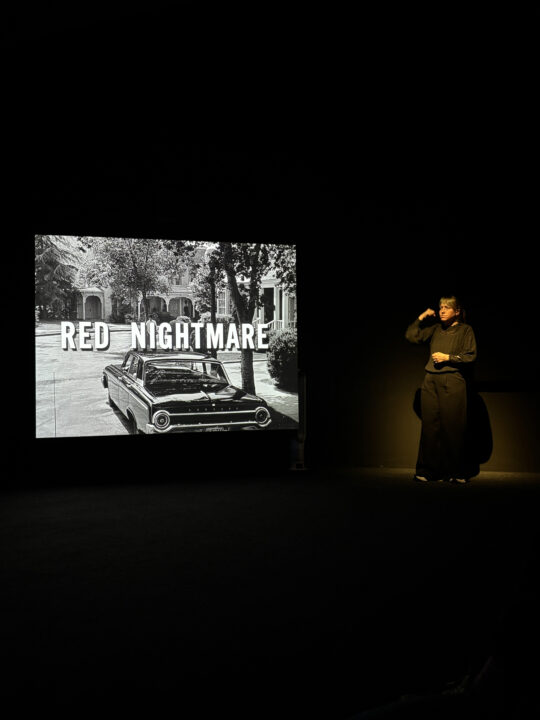
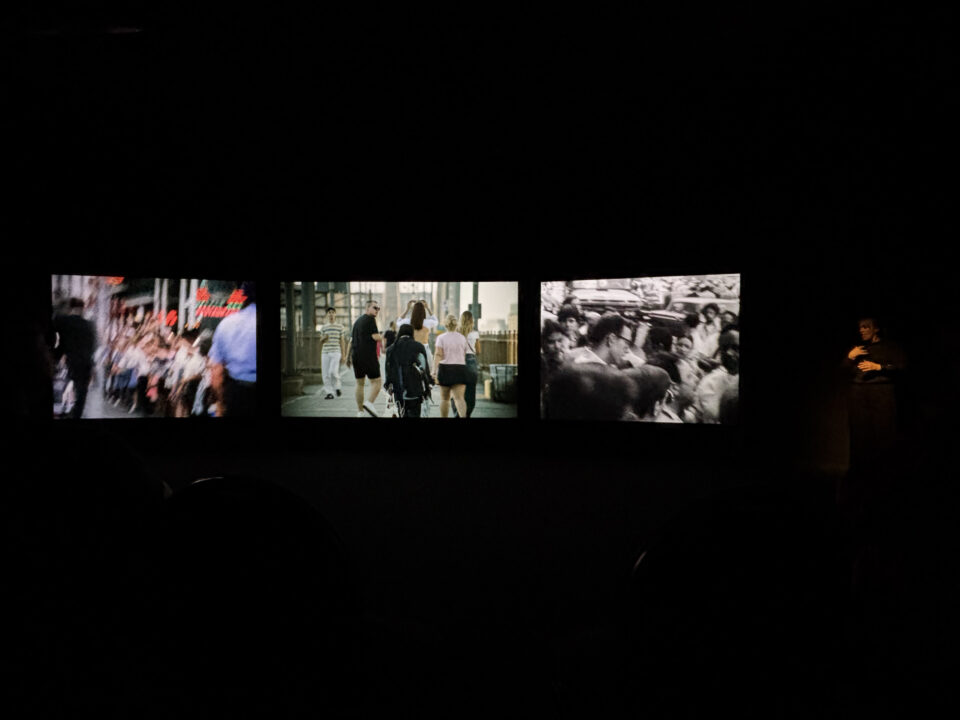
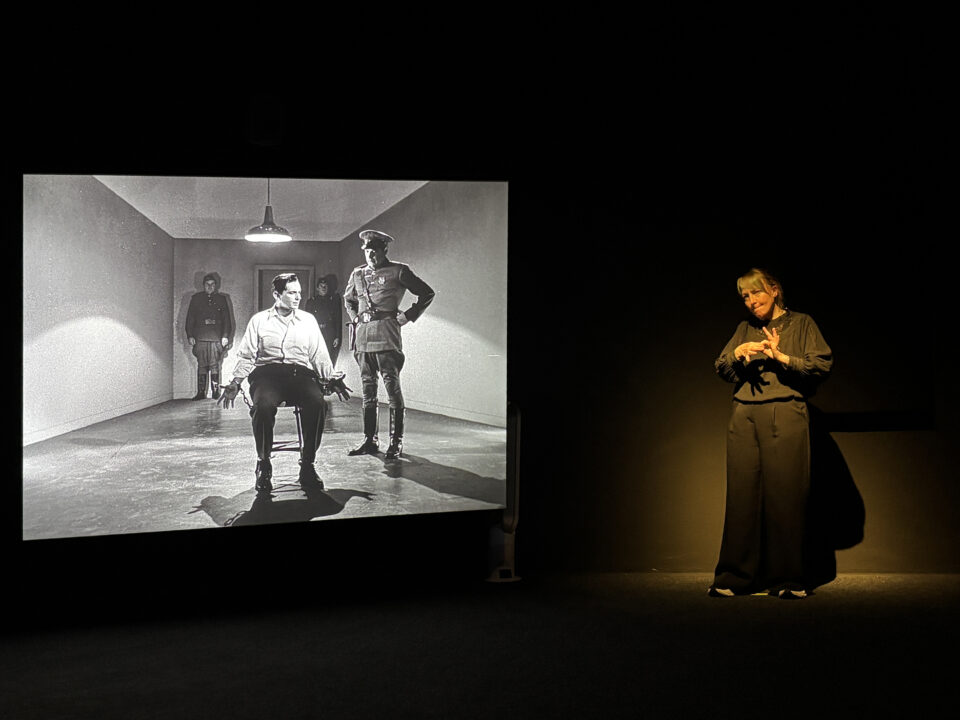
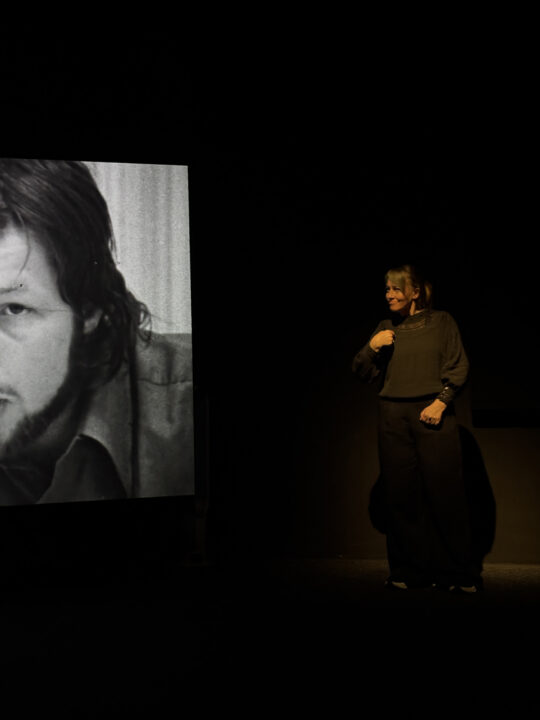
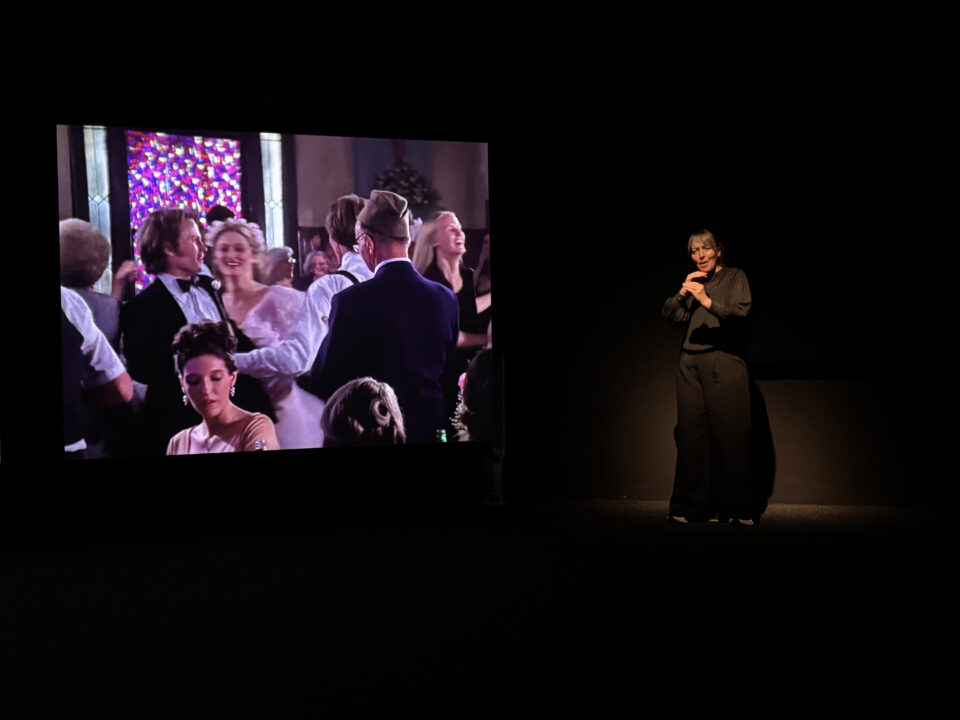
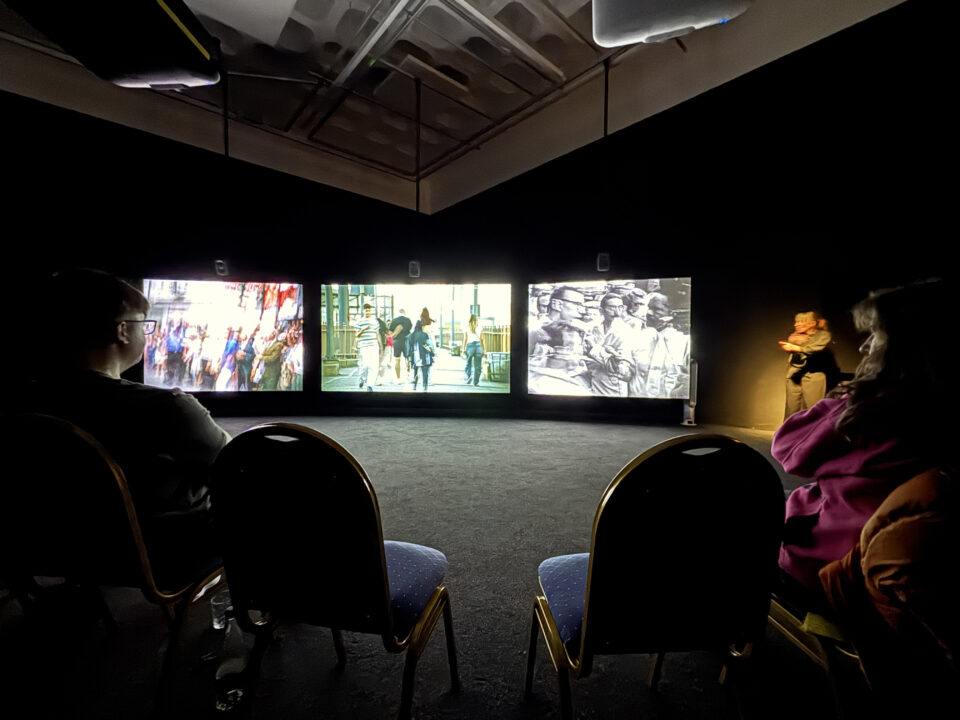
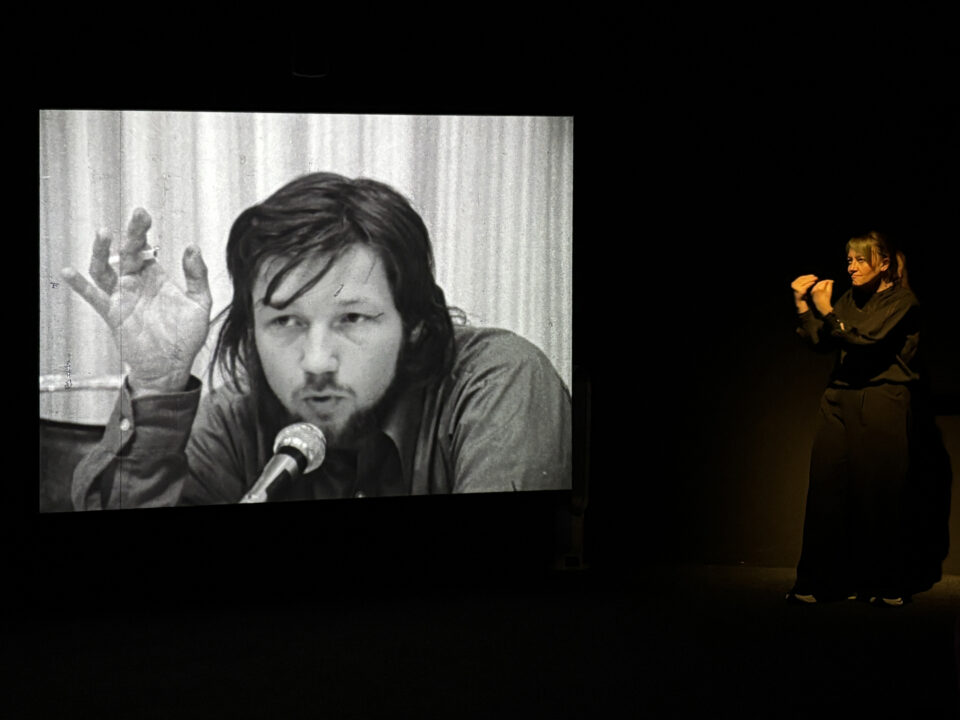
Book your free ticket for an evening screening with live BSL interpretation of THROUGH A MIRROR, DARKLY, a new three-channel film by Turner Prize nominated artist Naeem Mohaiemen. The film explores memorialisation, protest, and political violence through the lens of events in May 1970, when American students protesting domestic racism and overseas wars were met by state violence.
Doors: 6.15 pm
Film screening: 6.30 – 8 pm (approx)
Please note this film contains historic content featuring racialised language, images and graphic descriptions of violence, including death and acts of war. It may not be suitable for viewers under 16 years of age. Parental discretion advised.
About the film
As the Vietnam War came to its bloody end, for the American media, the memory of four American students shot dead at Kent State University was sometimes as emotionally charged as the millions of deaths in Vietnam.
In the decades that followed, a memorial community has formed around the ‘four dead in Ohio’. Yet while the deaths of students Alison Krause, Jeffrey Miller, Sandra Scheuer, and William Schroeder at Kent State, Ohio, are remembered, not many recall Phillip Lafayette Gibbs and James Earl Green, two students killed ten days later by police officers at Jackson State College, Mississippi, a Historically Black College.
By choreographing the relationship between archival footage and contemporary ceremonies memorialising the dead, THROUGH A MIRROR, DARKLY explores the role of memorials as a focal point for individual and collective grief. By comparing Kent and Jackson State, the project underscores blind spots around racialised violence and class tensions, made concrete in the disparity in coverage of these two campus shootings. The inclusion of stage-managed press conferences reveals the political machinations of the Nixon administration who fuelled a backlash to anti-war protests.
Mohaiemen deftly presents these intersecting strands, weaving together the voices of key political players, student leaders, and the fabled ‘man on the street’ alongside Vietnam veterans, to propose new interpretations of the events of May 1970 and their lasting impact.

About Naeem Mohaiemen
Naeem Mohaiemen was born in London, UK, grew up in Dhaka, Bangladesh and currently lives and works in New York, USA. He combines films, photography, drawings, and essays to explore forms of utopia-dystopia within families, borders, architecture, and uprisings – beginning in South Asia and then radiating outward to transnational collisions in the Muslim world after 1945.
Several conversations around ‘nonalignment’ as a concept container in contemporary art pivoted after the premiere of his film Two Meetings and a Funeral (2017) at Documenta 14, which was nominated for the Turner Prize (2018).
Mohaiemen’s museum projects are represented by Experimenter Gallery (India) and film screenings are represented by LUX (UK); his work is in major international collections including British Museum and Tate Modern (London), Museum of Modern Art (New York), MACBA (Barcelona), Van Abbemuseum (Eindhoven), Kiran Nadar Museum (Delhi), National Gallery of Singapore, Art Institute of Chicago, Samdani Art Foundation and Sharjah Art Foundation.
Mohaiemen is co-editor with Eszter Szakacs of Solidarity Must Be Defended (Budapest, 2023) and with Lorenzo Fusi of System Error: War is a Force That Gives Us Meaning (Siena, 2007). He is the author of Bengal Photography’s Reality Quest (Dhaka, 2025), Baksho Rohoshyo (Umea, 2024), Midnight’s Third Child (Dhaka, 2023) and Prisoners of Shothik Itihash (Basel, 2014). He is a faculty member at the Visual Arts Department, Columbia University.
Acknowledgments
Following the inaugural London presentation of the work by Artangel at Albany House (September – December 2025), the UK tour has been convened by Film and Video Umbrella and will travel to Bonington Gallery, Nottingham (2026), The Hunterian, University of Glasgow (2026), and John Hansard Gallery, Southampton (2026). The work will also be shown at the Wexner Center for the Arts at The Ohio State University, in Spring 2026.
Commissioned and produced by Artangel. Commissioned in partnership with Film and Video Umbrella and Wexner Center for the Arts at The Ohio State University. Supported by Experimenter.
Exhibition Partners: The Hunterian, University of Glasgow, John Hansard Gallery, Southampton and Bonington Gallery, Nottingham.
Artangel, FVU and John Hansard Gallery are generously supported using public funding by Arts Council England.
Join us for a free screening of a newly-translated documentary that explores the emergence of performance art in Cuba in the 1980s. The screening will be followed by a conversation with film director and artist Glexis Novoa.
The 1980s was a decade where a new generation of young artists were introducing a radical new artistic language and testing the bounds of the possible and the permissible in the process.
In the late 1970s and the 1980s multiple approaches towards the role and aesthetics of art in a socialist Cuba abounded. One particular strand saw an emerging generation of artists seeking to break free from what they saw as the bureaucratic and ideologically-orientated institutional systems and their ideas about culture. This change in attitude gave rise to a new visual language that prized interdisciplinary practices, multimedia, appropriated and referenced popular culture, religions, regional history and embraced parody and satire.
By the second half of the 1980s the arts were a site of intense discussion about artistic freedom and the nature of genuinely revolutionary art. Performance art played a key role in the articulation of the ideas and concerns of a budding generation.
Please note, this film contains some discussion of sex and nudity.
The film was initially made for the exhibition Losing the Human Form at the Reina Sofia Museum in Madrid, which looked at art in the 1980s in Latin America.
Taking part as part of Bonington Gallery’s Formations programme in partnership with NTU’s Postcolonial Studies Centre.
Glexis Novoa was born in Holguín, Cuba in 1964. Novoa was one of the most radical influences in the vibrant art scene known as, “The Renaissance of Cuban Art of the 80s”, and was the founder of the Provisional group, pioneers of performance, political activism and collectivist practices.
Novoa established himself in Miami in 1995 and has been sharing his time working in Havana and Miami since 2013. He is recognized for his site-specific wall drawings and ephemeral projects around the world, which exist on the border between ephemeral art and architecture. He frequently focuses on the architecture of power and community as the main subject.
Novoa’s work has been exhibited extensively around the world and is part of numerous museum collections.