

For the third year running, Bonington Gallery is delighted to be a host venue for CADALFEST (Celebrating Adivasi and Dalit Arts and Literature Festival), the first international festival series dedicated to creative practitioners whose work resists caste discrimination and social exclusion in India.
Events will take place online on our YouTube channel, or in person at the gallery. See the schedule below for more details.
This event celebrates Namdeo Dhasal, a poet who turned pain into poetry and poetry into resistance. Moving through his personal history, the rise of the Dalit Panthers, and his bold political presence, we reflect on the force he became in the anti‑caste movement. His verses in English will echo through the session, carrying the same urgency and beauty that defined his life.
Namdeo Dhasal (1949–2014) is one of the most groundbreaking and uncompromising literary voices in modern India. Poet, writer, activist, and co-founder of the Dalit Panthers, Dhasal revolutionised Marathi poetry by bringing into it the raw, unfiltered realities of caste violence, urban marginality, and the inner life of the oppressed. His poetry — fierce, experimental, and unapologetically political — challenged the aesthetic norms of Indian literature and carved out a new radical tradition of Dalit expression. Reading Dhasal on a global platform is especially important today, as his work speaks not only to the Indian context but to broader struggles for dignity, liberation, and social justice worldwide. His vision continues to inspire anti-caste movements, artists, and scholars across generations.
Sayali Sahasrabudhe, a PhD researcher at Trinity College Dublin, has worked in Indian theatre for over fifteen years and is an accomplished performer and artist. She will be joined by Abhishek Bhosale for a reading of selected poems by Namdeo Dhasal.
Although formerly perceived as utopian spaces, digital platforms mirror the contemporary society by replicating and reproducing social hierarchies. Building on this idea, our vision is to facilitate a programme on the intersectionality of caste, Adivasi identity, and gender within the online space with young content creators. How have online platforms shaped marginalised identities? How inclusive are these platforms in empowering their voices? How do young people from marginalised backgrounds engage with social injustice/ activism in this era of rising social media activity? And in this process of visibilising and asserting marginalities, how do the youth envision self-preservation online? These are some of the questions that we will be addressing throughout this event and with a special focus on online practices and their use of technology in negotiating their identities.
This session explores the intersections of literature, caste and lived experience through the work and journey of a Dalit woman writer from Kerala. Drawing from her experiences as a poet and fiction writer, Aleena reflects on how caste shapes literary production, questions of authorship, legitimacy, visibility and belonging within literary and media spaces. The session will explore the possibilities and tensions of writing from a Dalit standpoint, particularly through the lens of womanhood, while engaging with themes such as memory, mythology, faith, violence, joy and everyday realities. It will also reflect on the emotional and political realities of being a Dalit woman writer in contemporary literary culture, including negotiations around representation, tokenism and the burden of speaking from the margins. Ultimately, the session considers literature as a space of resistance, imagination, testimony and world/future making, asking what questions become possible when Dalit women become creators of literary memory.
This session shares my journey of building Shhor AI, an initiative that came directly out of my lived experience of navigating online violence as a trans non-binary, Indigenous, neurodivergent person from rural Tripura.
For years, my work as a political artist helped me build community, but it also made me a target. The hate speech and doxxing I faced were constant and personal. Existing moderation systems are largely designed in and for the Global North, and they fail to understand the cultural nuance and code-mixed language realities of Indian digital spaces.
Shhor AI emerged from this gap. We built a model trained on over 50,000 crowdsourced comments, annotated by marginalized communities themselves, grounding detection in lived experience. The system identifies hate speech across caste, disability, religion, gender, sexuality, and more within Indian code-mixed contexts. It is designed as a scalable API for real-time moderation.
This session is not just about the technology. It is about what it means to build from where we stand. Shhor has been community-driven and crowdfunded, built without institutional backing but with collective knowledge and urgency.
We will also discuss strategies to make big tech corporations listen to marginalized voices and prioritize our safety. This includes pushing for community-based moderation, building strong evidence, and demanding accountability in how platforms design and enforce safety.
The core idea is simple: marginalized communities are already building solutions. We are not lacking skill. We lack access to resources, networks, and decision-making power. This session asks for a shift from saving us to resourcing and trusting us.
Tribal identity extends beyond visible cultural expressions such as attire, art, wall paintings, handicrafts, songs, dance, food, or sustainable practices only. Tribal Identity embodies a lived and inherited system of knowledge transmitted across generations through practice. Indigenous crafts and culture have always fascinated the global audience but this has also led to their vulnerability to appropriation, misrepresentation, and loss of contextual meaning. It began with the appropriation of artwork, extended into fashion, and now questions ownership, gradually influencing and reshaping indigenous histories.
Today there is a challenge in documenting and representing tribal knowledge systems, particularly when interpreted through external perspectives that may prioritise aesthetics over authenticity. There is a need to preserving the raw indigenous culture and sharing insights that come from experience and true value. Drawing on observations from community-based practices and contemporary media landscapes, there seems to be a stark difference in these representations. Social media and popular culture contribute to the dilution and distortion of indigenous narratives. These short videos often are made as trends without proper referencing or sources, which sometimes leads to spreading misinformation. We are at the risk of reducing the cultural value of these rich traditions in the process of commercializing them for global consumption.
It is our responsibility to extend efforts towards community-led documentation, where cultural knowledge is authored, co-authored, or validated by community elders and practitioners. The role of the ‘link generation’ in preserving intangible heritage through ethical documentation, research, and representation. This approach seeks to safeguard cultural integrity while enabling meaningful engagement with wider audiences. I plan to emphasize how, without rigorous and authentic research and documentation, tribal histories are at the risk of being altered. This is evident in the way the attire (the patterns of the Phuta saree and the drape) from my community, the Santal tribe, is seeing a major shift in its aesthetics because of contemporary adaptations which are diverging from their cultural roots. Every craft and culture evolves naturally over time, in response to the current zeitgeist, but not at the expense of completely uprooting them from their inherent cultural significance.
Caste, as a structure and an ideology, continues to shape life across institutions, digital platforms, work spaces, and diasporic cultures. This session led by Christina Dhanuja will begin with a short primer introducing this system of graded hierarchy that is both unique and ubiquitous in its social, economic, and cultural manifestations. The session will then offer a deep dive into three contemporary anti-caste interventions, through the speaker’s own research and creative engagements. Participants will be led through caste-based diversity, equity, and inclusion initiatives within global workplaces and emerging conversations around policy and cultural reforms. The session will then delve into the inspiration and impact of the Dalit History Month project, a digital public archive and a transnational, community-led effort committed to documenting Dalit struggles, intellectual traditions, resistance, and joy. Finally, the session will examine how anti-caste art curation can create spaces for political imagination, public memory, cross-community learning, and new world-building.
Aleena is a Dalit feminist poet and writer from Kerala whose work explores themes of gender, sexuality, religion, and anti-caste politics. She holds an MA in English Literature from the School of Letters, MG University, Kerala. Her debut poetry collection, Silk Route (2021), which looks into gender, mythology, caste through 91 Malayalam poems was awarded the Kerala Sahitya Akademi Kanakashree Award in 2022. She’s a co-founder and core member of the poetry collective, The Reserved Compartment.
Shohini Barman is a Doctoral Candidate in the School of Social Sciences at Nottingham Trent University, United Kingdom. She holds a Bachelor of Arts and Master of Arts degree in English from Jadavpur University, India. Her research interests include Dalit Literature, Rajbanshi Literature, Translation, and South Asian Studies. Her PhD thesis explores the politics of caste in Bengal through the study of contemporary Bengali Dalit Literature and Rajbanshi Literature.
Aindriya Barua (they/them) is a queer Indigenous disabled artist and AI engineer from rural Tripura in northeast India. Their work is at the intersection of ethical artificial intelligence, art, and social justice. They founded Shhor, the UNFPA and World Summit Award winner for its intersectional feminist AI work combating online hate speech, especially against marginalized communities in the Indian context and its linguistic diversity. Aindriya’s work has been featured in national media as well as in art exhibitions across multiple countries. Through their art, they strive to make technology more inclusive, accessible, and rooted in people’s lived experiences.
Mrigakshi Das is a PhD candidate at Nottingham Trent University, UK. Her research, titled ‘Adivasi Literature and Cinema: Exploring Adivasi Alterity and Assertion’, focuses on questions of identity, resistance, and self-representation within Adivasi cultural production. She holds a Bachelor’s and a Master’s degree in English from the University of Delhi.
Christina Dhanuja is a writer, researcher, and strategist working at the intersections of caste, gender, faith, and justice. She is the co-founder of the #DalitHistoryMonth project and a founding member of the Global Campaign for Dalit Women. Christina has over 16 years of experience across India, China, Singapore, and the Netherlands, and consults with corporates, nonprofits, faith-based institutions, and universities on leadership development, caste-equity, and accountability frameworks. Her writing has been featured in The Wire, Outlook India, HuffPost, The Swaddle, GenderIT, and Verve. She is currently working on her first book, Dalit Women and the Fullness of Life.
Lipsa Hembram is the Founder and Creative Head of Galang Gabaan, a brand rooted in indigenous aesthetics and Odisha’s tribal textile heritage. Lipsa has a background in design from the National Institute of Fashion Technology (NIFT). She has been featured in national media including PSBT-DD documentary Kotpad Weaving, and her work has been showcased at various government-led textile initiatives as well as the Lakmé Fashion Week. She has been an invited speaker at academic institutions such as IIT, NIFT, NHDC, and SIDC, and in platforms such as TEDx. She continues to champion design as a tool for cultural preservation, social impact, and inclusive growth.
Basma Mahfoud-Vandermeersch is a PhD candidate at Université de Montpellier Paul-Valéry in co-supervision with BITS Pilani (Goa, India). She investigates the production and reception of translated Dalit writings specifically by Tamil and Telugu Dalit women and activists. Her research interests also consider diasporic writing and the possibilities of transnational collaboration, dialogue, and creation between marginalized communities (Dalits x Blacks x Queers x Muslims x Adivasis).
She is currently based in Paris and teaches ESL full time.
Kalyani Thakur Charal has been editing and publishing Neer Ritupatra, an anti-caste Bangla periodical for almost three decades. Navigating through a time wounded by atrocities on Dalit students and the disenfranchisement of the Dalit population, Neer has emerged as a window to Bengali Dalit women’s writings on Ambedkar, life writings, women’s writing across Indian languages, comparative reflections on caste and race, literary practices among the Bengali scheduled tribe communities. Neer attempts to make sense of anti-caste thought, and intends to forge connections and solidarities across languages and geographies. She will talk about how this journey began, how Neer was produced and circulated and how it survive all these years. What future plans await Neer?
In this conversation with Sayantan Mondal, Shohini Barman and Nicole Thiara, Kalyani Thakur Charal will also discuss her recent collection of critical essays, A Chandalini Speaks, published by Orient BlackSwan, and Andhar Bil’s publication in the UK by Tilted Axis. The conversation will be followed by Q&A.
Kalyani Thakur Charal is a Dalit feminist and poet writing in the Bengali language. She was born in Bagula, Nadia District, West Bengal, within the Matua community. Her publications include five volumes of poetry, including I Belong to Nowhere and Poems of Chandalini in English translation, an autobiography, a collection of short stories, collections of essays and various special issues of journals on topics such as folklore, water, refugees, and Dalit poetry. Her anthology of Indian women’s writing Dalit Lekhika: Women’s Writings from Bengal (with Sayantan Dasgupta) was published by Stree. Her groundbreaking experimental novel Andhar Bil – and Some People was published in English translation by ZUBAAN and has recently been released in the UK by Tilted Axis.
Dr Sayantan Mondal is an Associate professor and presently the head of the department of English and Other Languages, GITAM, Hyderabad, India. A graduate from the University of Hyderabad, Sayantan has been an Erasmus Mundus fellow at the University of Oxford. His areas of interest are Print readership, Nineteenth-Century Literature, Anti-caste Studies and Translation. His current research traces Bangla anti-caste Periodical culture (1960-2000) and its relationship with other Indian vernacular anti-caste print culture. In collaboration with Dr. Jondhale Rahul Hiraman, he has created a website (vernacularperiodical.gitam.edu) which provides access to around 10000 pages of Bangla and Marathi anti-caste periodicals. Some of his published works are: Of Caste-Class and Dalit Writing; An Introduction to the World of Monoranjan Byapari; Prantik theke Dalit: Nandonikatar Rajniti o Dalit Chetona (From Marginalised to Dalit: Politics of Aesthetics and Dalit Consciousness).
Shohini Barman is a Doctoral Candidate in the School of Social Sciences at Nottingham Trent University, United Kingdom. She holds a Bachelor of Arts and Master of Arts degree in English from Jadavpur University, India. Her research interests include Dalit Literature, Rajbanshi Literature, Translation, and South Asian Studies. Her PhD thesis explores the politics of caste in Bengal through the study of contemporary Bengali Dalit Literature and Rajbanshi Literature.
Dr Nicole Thiara is co-lead of Nottingham Trent University’s Postcolonial and Global Studies Research Group and Principal Investigator on the AHRC-funded Research Network Series ‘Writing, Analysing, Translating Dalit Literature’ and its Follow-on Grant ‘On Page and on Stage: Celebrating Dalit and Adivasi Literatures and Performing Arts’. She teaches postcolonial and contemporary literature at Nottingham Trent University, UK. Her area of research is Dalit and Adivasi literature and her current research project is on the representation of modernity in Dalit literature. Her publications include Salman Rushdie and Indian Historiography: Writing the Nation into Being (Palgrave Macmillan, 2009), ‘The Caste of Nature: Wholesome Bodies and Parasites in Bimal Roy’s Sujata and Gogu Shyamala’s “A Beauteous Light”, The Routledge Companion to Caste and Cinema in India (Routledge, 2022), ‘The Colonial Carnivalesque in Mulk Raj Anand’s Untouchable and Amitav Ghosh’s Sea of Poppies’, Journal of Postcolonial Writing 52: 6 (2016), ‘Subaltern Experimental Writing: Dalit Literature in Dialogue with the World’, Ariel 47:1-2 (2016), pp. 253-80. With Judith Misrahi-Barak and K. Satyanarayana, she co-edited the critical volume Dalit Text: Aesthetics and Politics Re-imagined (Routledge, 2019) and special issue on Dalit Literature in the Journal of Commonwealth Literature 54 (1), March 2019.
With poems, songs and stories, Gogu Shyamala will engage in a dialogue with the writings by Dalit women who unveil mundane lived and shared experiences of those who are located at the lowest strata of society and whose lives are coloured by divisions of class, caste and gender. The context of this intersectional oppression of Dalit women is a civil society that is fragmented by religion, while caste compartmentalises India into 3000 fragments and about 25,000 subdivisions. Unlike religion, the division among castes is invisible but firmly in place. This systematic division, called the ‘Caste System’, is premised on codification of the five-fold varna system. This codification subscribes to an ideology of divisions in a hierarchy akin to a vertical ladder, naturalising and internalising the idea of purity and pollution of castes by religion, effecting untouchability and inhumanity. All top four varnas thereby humiliate the last varna in terms of the economy, ethnicity, culture and assertion.
Gogu Shyamala will discuss how the form of speculative fiction is well suited to explore all these caste contradictions and dichotomies in order to create anti-caste literature and the history of contemporary conditions. She will draw on poems and songs as well as her recently published novelette, “The Phantom Ladder” (in translation from Telugu by Divya Kalavala), in The Blaft Book of Anti-Caste SF by BLAFT Publications.
Gogu Shyamala will be in conversation with Divya Kalavala and Priteegandha Naik, followed by Q&A.
Dr Divya Kalavala is an academic and translator. She was awarded the Charles Wallace India Trust Translation Fellowship for the year 2023–24 at the British Centre for Literary Translation at the University of East Anglia, UK. In the subsequent year, she was awarded the UEA Archives and Collections Visiting Fellowship (2024–25) at the Sainsbury Centre for Visual Arts for her project, ‘Mithila Art from India’.
She holds a doctoral degree in Film Studies from The English and Foreign Languages University and has been teaching at Manipal Academy of Higher Education, Bengaluru. Divya translates from her mother tongue, Telugu, into English and is primarily interested in translating literary texts from the margins as a form of political solidarity.
Dr Priteegandha Naik is an Assistant Professor at the Mukesh Patel School of Technology Management & Engineering, NMIMS University, where she teaches Communication Skills and other Humanities-centric courses. She is interested in exploring caste and gender in Indian Science Fiction. In particular, she has worked on Dalit Futurism and on understanding Dalit futures in speculative fiction, art, literature, and film and their consequent relevance to the anti-caste movement.
Dr Gogu Shyamala is one of the foremost contemporary Dalit writers in India, as an award-winning author, researcher, editor, and biographer writing in Telugu. Her collection of short stories Father may be an elephant and mother only a small basket, but… in English translation is a landmark in Indian literature, and her most recent publication is the short story ‘The Phantom Ladder’ (in translation from Telugu by Divya Kalavala), in The Blaft Book of Anti-Caste SF. Among her publications are anthologies of Dalit women’s writings in Telugu, and the biography of the first Dalit woman legislator, T.N. Sadalakshmi in the former state of Andhra Pradesh, India. She is the co-editor of the Oxford Anthology of Telugu Dalit Writing in English (OUP). She holds a PhD in the area of Dalit Women Biographies, Gender and Caste in Telangana, from the English and Foreign Languages University, Hyderabad. She studies Dalit women’s literature and the history and mythology of Dalit literature as well as collecting palm leaf manuscripts of Dalit Puranas for contemporary scholarly studies. Dr Gogu was a research fellow at the Anveshi Research Centre for Women’s Studies, Hyderabad for 21 years, from 1999 to 2020, and she was awarded a fellowship at IAS-Nantes The Institute for Advanced Study of Nantes (2020- 21), France.
Sambhaji Bhagat will be in conversation with Abhishek Bhosale and reflect on his artistic journey, perform selected songs, and speak about the role of music in shaping anti-caste cultural politics in India.
Sambhaji Bhagat is one of Maharashtra’s most influential cultural figures — a musician, Lokshahir, and activist whose work spans artistic, intellectual, and social justice spheres. Renowned for his powerful use of folk music, he gives voice to the struggles and aspirations of marginalised communities, particularly Dalits, and his performances across India function not simply as entertainment but as instruments of political education and resistance. His academic engagement and long-standing participation in social movements further reflect his commitment to challenging structural inequalities. His artistic vision is perhaps most widely recognised through the acclaimed film Court, and the theatre play Shivaji Underground in Bhim Nagar Mohalla, where his music played a central narrative and political role, leaving a lasting imprint on contemporary cultural debates.
Abhishek Bhosale is a writer, journalist, and doctoral researcher whose work emerges from more than a decade of engagement with caste, land, and everyday political life in Western India. Currently based in London, he is pursuing his PhD at SOAS University of London, examining the outcomes of land rights in Western India. His research, Land for Emancipation: Development with Dignity and Dalit Land Struggle in India, explores how land becomes a site of dignity, imagination, and resistance for Dalit households. Before entering academia, he worked as a journalist and columnist, travelling extensively across India to report on the agrarian crisis, land conflicts, caste violence, caste boycotts, protest cultures, and the lived experiences of Dalit communities. His writing is shaped by long conversations in drought-prone villages, evenings spent in Dalit vastis, and a commitment to bringing marginalised voices into public discourse. His recent longform piece in The Wire, “An Ambedkarite Voice Moving Through Latur’s Dalit Vastis,” exemplifies his ability to weave reportage with reflective narrative. In 2025, The Wire also profiled his anti-caste organising in UK universities, highlighting the emergence of a new caste critical intellectual culture on British campuses and his role within it. At SOAS he currently serves as President of the SOAS Ambedkar Society, curating events that bring Ambedkarite ideas into dialogue with global student movements. His academic background spans journalism, international relations, and development studies, but his most formative learning has come from years spent documenting the cultural and political life of Dalit communities — recording oral histories, following land and water rights campaigns, and tracing the travel of Ambedkarite thought across rural, academic, and diasporic spaces.
Songs have always been an important form of expression in the anti‑caste movement in India. They talk about caste oppression and celebrate the life, work, and values of Dr. Babasaheb Ambedkar and Siddharth Gautam Buddha. But their role doesn’t end there. These songs also raise serious questions about both caste and capitalist society.
This online event will explore how songs contribute to developing a combined understanding of intersections of caste and class in Dalits’ exploitation, struggle and resistance — a framework Abhishek Bhosale refers to as “CLASTE”. It will consider the political life of musical traditions and their capacity to articulate everyday struggles and solidarities.
Abhishek Bhosale will be in conversation with Judith Misrahi-Barak, Purnachandra Naik and Nicole Thiara, followed by Q&A.
Abhishek Bhosale is a writer, journalist, and doctoral researcher whose work emerges from more than a decade of engagement with caste, land, and everyday political life in Western India. Currently based in London, he is pursuing his PhD at SOAS University of London, examining the outcomes of land rights in Western India. His research, Land for Emancipation: Development with Dignity and Dalit Land Struggle in India, explores how land becomes a site of dignity, imagination, and resistance for Dalit households.
Before entering academia, he worked as a journalist and columnist, travelling extensively across India to report on the agrarian crisis, land conflicts, caste violence, caste boycotts, protest cultures, and the lived experiences of Dalit communities. His writing is shaped by long conversations in drought-prone villages, evenings spent in Dalit vastis, and a commitment to bringing marginalised voices into public discourse.
His recent longform piece in The Wire, “An Ambedkarite Voice Moving Through Latur’s Dalit Vastis,” exemplifies his ability to weave reportage with reflective narrative. In 2025, The Wire also profiled his anti-caste organising in UK universities, highlighting the emergence of a new caste‑critical intellectual culture on British campuses and his role within it. At SOAS he currently serves as President of the SOAS Ambedkar Society, curating events that bring Ambedkarite ideas into dialogue with global student movements.
His academic background spans journalism, international relations, and development studies, but his most formative learning has come from years spent documenting the cultural and political life of Dalit communities — recording oral histories, following land and water rights campaigns, and tracing the travel of Ambedkarite thought across rural, academic, and diasporic spaces.
Judith Misrahi-Barak is Professor Emerita in Postcolonial Studies at the English Department, Université de Montpellier Paul-Valéry, France. Her prime areas of specialisation are Anglophone Caribbean and Indo-Caribbean literatures, diaspora and migration. Her monograph in French Entre Atlantique et océan Indien : les voix de la Caraïbe anglophone (2021) was published with Classiques Garnier. She is General Editor of the series PoCoPages published by the University Presses of the Mediterranean (Pulm, Montpellier). She is currently involved in several transdisciplinary collaborative research projects such as Kala Pani Crossings (see the co-edited volumes Kala Pani Crossings, Routledge 2021 & 2023); or ‘Thanatic Ethics: the Circulation of Bodies in Migratory Spaces’ (see the Special Issue for Interventions: International Journal of Postcolonial Studies, 2023). She has also acted as Co-Investigator on AHRC-funded series on Dalit and Adivasi Literatures with Dr NicoleThiara (NTU) as Principal Investigator. In this field, she has co-edited a Special Issue for The Journal of Commonwealth Literature (2019), as well as Dalit Literatures in India (Routledge, 2015), Dalit Text: Aesthetics and Politics Re-imagined (Routledge, 2019) and The Routledge Companion to Caste and Cinema in India (Routledge, 2022).
Dr. Purnachandra Naik is currently teaching at the Centre for Comparative Literature at University of Hyderabad. His PhD research monograph titled “Reading the Rejected: Dirt in Dalit Literature”, which he completed at Nottingham Trent University, is under contract with Routledge. He has published research articles on Dalit literature, caste, animals, and Indian cinema in edited compilations published by Routledge and CUP. His review of the book Dalit Kitchens of Marathwada was published in “Food, Culture and Society” (Taylor & Francis). His reviews and commentaries have also been published in the EPW, Outlook, Indian Express, and The Book Review.
Dr Nicole Thiara is co-lead of Nottingham Trent University’s Postcolonial and Global Studies Research Group and Principal Investigator on the AHRC-funded Research Network Series ‘Writing, Analysing, Translating Dalit Literature’ and its Follow-on Grant ‘On Page and on Stage: Celebrating Dalit and Adivasi Literatures and Performing Arts’. She teaches postcolonial and contemporary literature at Nottingham Trent University, UK. Her area of research is Dalit and Adivasi literature and her current research project is on the representation of modernity in Dalit literature. Her publications include Salman Rushdie and Indian Historiography: Writing the Nation into Being (Palgrave Macmillan, 2009), ‘The Caste of Nature: Wholesome Bodies and Parasites in Bimal Roy’s Sujata and Gogu Shyamala’s “A Beauteous Light”, The Routledge Companion to Caste and Cinema in India (Routledge, 2022), ‘The Colonial Carnivalesque in Mulk Raj Anand’s Untouchable and Amitav Ghosh’s Sea of Poppies’, Journal of Postcolonial Writing 52: 6 (2016), ‘Subaltern Experimental Writing: Dalit Literature in Dialogue with the World’, Ariel 47:1-2 (2016), pp. 253-80. With Judith Misrahi-Barak and K. Satyanarayana, she co-edited the critical volume Dalit Text: Aesthetics and Politics Re-imagined (Routledge, 2019) and special issue on Dalit Literature in the Journal of Commonwealth Literature 54 (1), March 2019.
Bonington Gallery is delighted to host the culmination of this year’s CADALFEST (Celebrating Adivasi and Dalit Arts and Literature Festival).
After two successful festivals between 2022-24, at locations within the UK and India, this third instalment will culminate with a two-day programme of screenings, discussions, workshops and masterclasses at Bonington Gallery, offering audiences a closer, more sustained engagement with contributors than on previous occasions.
This new, more interactive format will allow audiences to work closely, and embark on a two-day journey, with the filmmaker Jayan K. Cherian, the writers and poets Gogu Shyamala and Jitendra Vasava, the writers and researchers Gopika Jadeja and Priteegandha Naik, as well as the Jangama Collective.
This year’s festival also celebrates the 10-year anniversary of the network on Dalit and Adivasi literature that was launched by the first conference on Dalit literature at Nottingham Trent University in June 2014.
10 am – 12 pm: Gopika Jadeja and Jitendra Vasava, ‘Adivasi lives in forest, village, city’.
Jitendra Vasava and Gopika Jadeja have been working over the past decade to translate and publish Adivasi poetry from western India, including Vasava’s own poetry. Beginning with a song in celebration of the Earth, Vasava and Jadeja will weave through Vasava’s poetry in Dehwali Bhili and English translation, video footage of readings by other Adivasi poets and reflections on poetry, orality and Adivasi struggles.
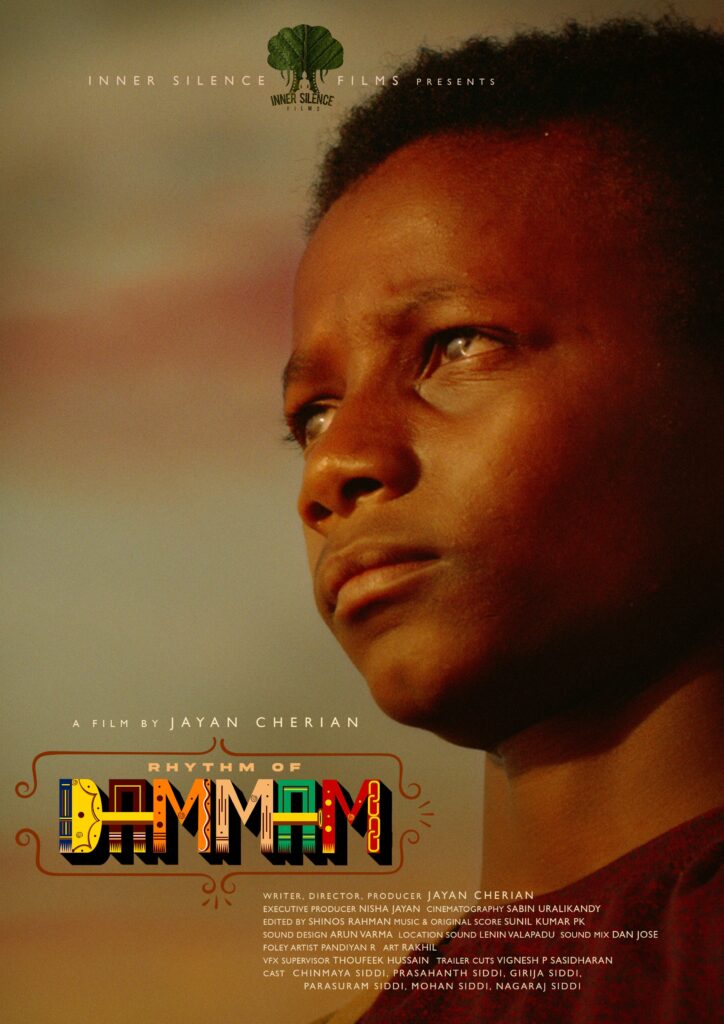
1 – 3 pm: Screening of Rhythm of Dammam, a film by Jayan K. Cherian, followed by a discussion with the filmmaker.
In Uttara Kannada, India, Jayaram Siddi, a twelve-year-old boy, is believed to be possessed by the spirit of his late grandfather, Rama Bantu Siddi. Despite seeking help from local black magicians, Jayaram’s condition remains unchanged. He escapes into a dream world, using ‘magical’ instruments from his grandfather to connect with his ancestors. However, he becomes overwhelmed by the agonizing history of his ancestors’ chattel slavery, losing touch with reality. Jayaram drops out of school, and his family strives to restore his balance by embracing tribal rituals and Dammam music, both vital to their cultural heritage. The film delves into Jayaram’s struggle with intergenerational trauma, emphasizing the challenges faced by him and his family in finding healing and stability.
Rhythm of Dammam is a groundbreaking production that brings to light the little-known Siddi community of India, also known as the Sheedi or Habshi, who primarily reside in regions like Karnataka, Gujarat, and Hyderabad in Telangana. The Siddi people trace their ancestry to the Bantu people from Southeast Africa, who were enslaved by Portuguese traders and brought to the Indian subcontinent between 1530 and 1740. While slavery was declared illegal in British India by 1835 (and continued until 1865 in Portuguese-controlled Goa), the Siddi people endured a different form of bondage within India’s complex caste system after abolition.
Despite some progress in Indian society, the Siddi community continues to experience discrimination and marginalization, limiting their social and economic mobility due to their position within the caste hierarchy. Nevertheless, the Siddi people have shown remarkable resilience in preserving their unique cultural identity. They have achieved this by maintaining their ancestral customs while incorporating elements of Indian culture, particularly traditional Dammam music and tribal rituals. The journey of the Siddi people—from enslavement to current caste-based challenges—is a moving tale of determination and survival. It highlights the enduring impact of societal oppression while showcasing the strength of cultural heritage and community solidarity. The film Rhythm of Dammam offers a fresh perspective on the complex dynamics of caste, race, and identity in contemporary Indian society. It encourages viewers to question their preconceptions and biases while acknowledging the resilience of the human spirit in its pursuit of dignity and freedom.
3:30 – 5:30 pm: Masterclass with Jayan K. Cherian.
In this interactive masterclass, Jayan K. Cherian will focus on the logistics of independent filmmaking in a remote village setting—navigating limited infrastructure, working with non-professional actors, and building a creative process rooted in mutual trust. He will also share insights from his experience living and working with the Siddi community—how they prepared documentary subjects to step into fictional roles and developed the screenplay through oral histories, local legends, and the mythologies shared by elders. These became the foundation for a story that reflects the community’s collective memory, while also raising questions about who gets to represent whom, and how (the politics of representation in cinema).
10 am – 12:30 pm: Priteegandha Naik’s workshop ‘Reclaiming Tomorrows: Liberation through Dalit Futurism’.
This workshop aims to re-imagine and rewrite the intended telos of the caste system as envisioned by Vinayak Damodar Savarkar. It will employ speculative fiction to resist, challenge, and create anti-caste futures. The workshop uses Dalit futurism as a toolkit to build blueprints of tomorrows and bring them to life. It will use Dalit futurism to critique, dream, and create new narratives of hopeful and collaborative futures.
1:30 – 3:30 pm: Gogu Shyamala’s presentation ‘Pain resonates in speculative fiction’ and conversation with Priteegandha Naik, chaired by Basma Mahfoud-Vandermeersh.
In this presentation with poems, songs and stories, Gogu Shyamala will engage in a dialogue with the writings by Dalit women who unveil mundane lived and shared experiences of those who are located at the lowest strata of society and whose lives are coloured by divisions of class, caste and gender. The context of this intersectional oppression of Dalit women is a civil society that is fragmented by religion, while caste compartmentalises India into 3000 fragments and about 25,000 subdivisions. Unlike religion, the division among castes is invisible but firmly in place. This systematic division, called the ‘Caste System’, is premised on codification of the five-fold varna system. This codification subscribes to an ideology of divisions in a hierarchy akin to a vertical ladder, naturalising and internalising the idea of purity and pollution of castes by religion, effecting untouchability and inhumanity. All top four varnas thereby humiliate the last varna in terms of the economy, ethnicity, culture and assertion.
Gogu Shyamala will discuss how the form of speculative fiction is well suited to explore all these caste contradictions and dichotomies in order to create anti-caste literature and the history of contemporary conditions. She will draw on poems and songs as well as her recently published short story, “The Phantom Ladder” (in translation from Telugu by Divya Kalavala), in The Blaft Book of Anti-Caste SF by BLAFT Publications.
4 – 6 pm: Jangama Collective, represented by Lakshmana K P and Mohit Kaycee, screening of the play DaklaKatha DeviKavya, followed by a discussion with Lakshmana K P and Mohit Kaycee.
Daklakatha Devikavya is an experimental play drawing on the epic poetry and stories of the important Kannada writer and founder-member of the Dalit Sangharsha Samiti, K.B. Siddaiah. This experimental piece begins with a re- reading of a cosmogonic myth from a community that is oppressed even amongst the oppressed narrating the origins of the world and of life on it. The play progresses through weaving and unravelling untouchable rituals, beliefs, hunger and desires through song and storytelling. For untouchable communities nudi (speech, sound, voice, and word) is like breath that cannot be separated from the body. The play uses instruments such as the areye and tamte as vines of nudi that enmesh the narrative and sprout new directions from within. Thereby opening up the untouchable world as a world of deep sonic imprints. In a context such as this, the play confronts what happens when the ‘written word’ that has so far been unreachable collides with and becomes an organ of the untouchable body, giving rise to a new relationship of intimacy and struggle. The play provokes an exploration of how the received insights through the experience of untouchability and the ‘written word’ force us to confront what it means to be human in the depths of our being.
Jayan Cherian, from Kerala, holds an MFA in filmmaking from The City College of New York as well as a BA in film and creative writing from Hunter College. He has received numerous honours and recognition for his cinematic works, which have been featured at prestigious film festivals around the world, including the Berlin International Film Festival, Durban International Film Festival, BFI London Lesbian Gay Film Festival, NARA International Film Festival, Rio-de-Janeiro International Film Festival, Kolkata International Film Festival, and Montreal World Film Festival. His career features notable titles including Ka Bodyscapes (2016), Papilio Buddha (2014), The Shape of the Shapeless (2010), and the latest Rhythm of Dammam (2024). He has also contributed significantly to numerous documentaries and short films over the course of his career.
Basma Mahfoud-Vandermeersch is an ESL teacher based in Paris and pursuing a PhD at Université de Montpellier Paul-Valéry (France) in co-supervision with BITS Pilani Goa (India). Her research focuses on the production and reception of translated Dalit writings by women from South India and the diaspora. While looking at the articulation of caste in migration, she is also interested in exploring the possibilities of transnational collaboration, dialogue, and creation between marginalized communities (Dalits x Blacks x Queers x Muslims x Adivasis).
Dr Gopika Jadeja is a bilingual poet and translator and writing in English and Gujarati, active both in her native India and internationally. As part of a broadly engaged creative, scholarly and pedagogical practice, Gopika is Editor-at-Large (Singapore) for Wasafiri: International Contemporary Writing and Coordinating Editor of the journal PR&TA: Practice, Research and Tangential Activities—a peer-reviewed journal of creative practice with a focus on SE Asia based in Singapore. Besides this, she publishes and edits a print journal and a series of pamphlets that are part of a performance-publishing project called ‘Five Issues’. A recipient of the inaugural PEN Presents Award (South Asia) and the Charles Wallace Scholarship for Creative Writing, Gopika’s poetry and translations have been published in Modern Poetry in Translation, Asymptote, Cha: An Asian Literary Journal, Wasafiri, Cordite Poetry Review, Indian Literature, Sahcharya, Vahi, etc. Her work has also appeared in anthologies like The Art and Craft of Asian Stories: A Writer’s Guide and Anthology, A Thousand Cranes for India: Reclaiming Plurality Amid Hatred, No News: 90 Poets Reflect on a Unique BBC Newscast, The Blaft Book of Anti-Caste SF, etc. Gopika is currently working on a project of English translations of poetry from Gujarat, including Dalit and Adivasi poetry as well as a monograph based on her doctoral research. Her collection of poetry, What Parvati Does Not Say is forthcoming from Red River Press, India.
Judith Misrahi-Barak is Professor in Postcolonial Studies at the English Department, Université de Montpellier Paul-Valéry, France. She is a member of the research centre EMMA, and her areas of specialisation and publication are Anglophone Caribbean, Indo- and Sino-Caribbean literatures, diaspora and migrant writing, and Dalit literatures. Her monograph in French is entitled Entre Atlantique et océan Indien : les voix de la Caraïbe anglophone (Classiques Garnier, 2021). She is Co-Investigator on the AHRC-funded Research Network Series ‘Writing, Analysing, Translating Dalit Literature’ and its Follow-on Grant ‘On Page and on Stage: Celebrating Dalit and Adivasi Literatures and Performing Arts’. She is also General Editor of the series PoCoPages (Pulm, Montpellier) and she has co-edited special issues for The Journal of Commonwealth Literature (‘Dalit Literature’, 2019) and for Interventions: International Journal of Postcolonial Studies (‘Thanatic Ethics’, 2023). Among the volumes she has co-edited are the recent Kala Pani Crossings: Revisiting 19th century Migrations from India’s Perspective (Routledge, 2021), Kala Pani Crossings, Gender and Diaspora: Indian Perspectives (Routledge, 2023) and The Routledge Companion to Caste and Cinema in India (Routledge, 2023).
Shohini Barman is a Doctoral Candidate at the School of Arts and Humanities at Nottingham Trent University. She completed her Undergraduate and Master’s degrees in English from Jadavpur University (Kolkata, India). Her current research is on Dalit Literature in Bengal.
Mrigakshi Das is a Ph.D. candidate in English Literature at Nottingham Trent University, UK. Her research focuses on the assertion of Adivasi identity in Adivasi literature and cinema, with broader interests in Adivasi and Indigenous studies. She holds a Bachelor’s and a Master’s degree in English from the University of Delhi, India.
Dr Priteegandha Naik is an Assistant Professor at the Mukesh Patel School of Technology Management & Engineering, NMIMS University, where she teaches Communication Skills and other Humanities-centric courses. She is interested in exploring caste and gender in Indian Science Fiction. In particular, she has worked on Dalit Futurism and on understanding Dalit futures in speculative fiction, art, literature, and film and their consequent relevance to the anti-caste movement.
Dr Gogu Shyamala is one of the foremost contemporary Dalit writers in India, as an award-winning author, researcher, editor, and biographer writing in Telugu. Her collection of short stories Father may be an elephant and mother only a small basket, but… in English translation is a landmark in Indian literature, and her most recent publication is the short story ‘The Phantom Ladder’ (in translation from Telugu by Divya Kalavala), in The Blaft Book of Anti-Caste SF. Among her publications are anthologies of Dalit women’s writings in Telugu, and the biography of the first Dalit woman legislator, T.N. Sadalakshmi in the former state of Andhra Pradesh, India. She is the co-editor of the Oxford Anthology of Telugu Dalit Writing in English (OUP). She holds a PhD in the area of Dalit Women Biographies, Gender and Caste in Telangana, from the English and Foreign Languages University, Hyderabad. She studies Dalit women’s literature and the history and mythology of Dalit literature as well as collecting palm leaf manuscripts of Dalit Puranas for contemporary scholarly studies.
Dr Nicole Thiara is Senior Lecturer in English at Nottingham Trent University, UK, and Co-Lead of the Postcolonial and Global Studies Research Group as well as Principal Investigator on the AHRC-funded Research Network Series ‘Writing, Analysing, Translating Dalit Literature’ (2014-16) and its Follow-on Grant ‘On Page and on Stage: Celebrating Dalit and Adivasi Literatures and Performing Arts’ (2020-23). She teaches postcolonial and contemporary literature, and her area of research is Dalit, Adivasi and diasporic South Asian literature; her current research project is on the representation of modernity in Dalit literature. Her recent publications include ‘The Caste of Nature: Wholesome Bodies and Parasites in Bimal Roy’s Sujata and Gogu Shyamala’s “A Beauteous Light”, The Routledge Companion to Caste and Cinema in India, ed. by Judith Misrahi-Barak and Joshil K. Abraham (Routledge, 2023) and, with Judith Misrahi-Barak and K. Satyanarayana, the critical volume Dalit Text: Aesthetics and Politics Re-imagined (Routledge, 2019) and the special issue on Dalit Literature in the Journal of Commonwealth Literature 54 (1), March 2019.
Dr Jitendra Vasava is a poet from Mahupada village Narmada district of Gujarat, who writes in Dehwali Bhili, Hindi and Gujarati. He is the founding president of Adivasi Sahitya Academy and edits Lakhara, a magazine dedicated to Adivasi voices. Following his doctoral research on the cultural and mythological aspects of Dehwali Bhili oral narratives he is doing research on the environmental knowledge systems of the Bhils as a post-doctoral fellow at the Indian Institute of Technology, Gandhinagar. He has published five books on Adivasi oral literature, an anthology of Adivasi poetry from Gujarat and a book of poetry.
Jangama Collective is a Bangalore-based group of theatre artists with diverse cultural backgrounds who believe in creating cultural and political awareness choosing theatre as their way of expression. As an extension of this, the group has engaged itself in creative processes like education, literature, publishing, cinema and social struggles.
Lakshmana K P, founder member of Jangama Collective is an actor, director, poet, and performance educator from Karnataka, India. He graduated from the Intercultural Theatre Institute Singapore in 2018 and from Ninasam Theatre Institute in 2012. Lakshman has been exploring questions around Dalit aesthetics in performance, and his two recent plays We the People of India and Daklakatha Devikavya explore intersecting questions about Dalit political modernity and cultural memory.
Santosh Dindaguru is from Dindaguru of Channarayapattana-taluk-Karnataka. He holds a diploma from Ninasam and a master’s degree in Drama. He was inspired by Babasaheb Ambedkar’s thoughts and has persistently tried to bring awareness about caste discrimination and its impact on the society through poems, stories and plays. He is the founder of “Neladani”, an organization in his village-Dindaguru. Santosh is a recipient of DeccanHerald ChangeMaker-Award in 2023. Currently he is working as a theatre teacher in Poorna Learning Center in Bangalore.
Bharath Dingri is from Ashapura, Raichur District-Karnataka. He was introduced to the Songs of Resistance at a very young age by his father who is a street play artist and grew up traveling to different villages and regions and played the Tamate along with his father during performances. Having worked in well-known repertories in Karnataka, he did his Diploma from Ninasam. He also has a Diploma in Journalism.
Bindu Raxidi is from Raxidi of Sakaleshapura-taluk-Karnataka who grew up as a child artist. She completed her BBM. Later she worked in BPO agency in Mangalore. She holds a Diploma from Ninasam Theatre Institute and went on to be a part of Ninasam-Tirugaata Repertory for three years. She founded a theatre team called “Act-React” in Bangalore. She has established herself as an actress in Kannada and Tulu Cinema Industry and in Kannada theatre.
Ramika Chaithra is from Bangalore, Karnataka who has been doing theatre for the past 8 years. She completed her theatre course from Banna Abhinaya Rangashaale and attended various theatre workshops in Bangalore. She has acted in various theatre groups and also went on to act in TV serials and Cinema. After completing her B.Com., she has taken up acting and modelling as her profession.
Narasimharaju B K originating from Bevinahalli Sira, Karnataka, Narasimharaju’s expertise lies in playing the areye (urume). He comes from a lineage of areye players, having started when he was 6 years old. He commonly performs in festivals and ceremonies, and he has performed the areye in a contemporary performance setting in Singapore for a dance piece ’Yahi’. He also holds a master’s degree in Kannada literature and a bachelor’s in Education.
Shwetha Rani HK is a theatre practitioner from Hassan, working in theatre for the past 11 Years. She holds a Diploma in theatre by Ninasam and the National School of Drama, New Delhi, specialization in acting. She worked as an actress and technician in Ninasam, Shivsanchara and Janamanadaata Reportry Companies. She taught in Ninasam for two years. Currently, she is teaching and also the Principal of Sri Shivakumara Rangaprayoga Shaale, Sanehalli.
Poorvi Kalyani is a singer, composer and actor who grew up in the presence of theatre from a very young age as her parents are from Professional modern Theatre. Formally trained in theatre music by her mother, she later on practiced Hindustani and Carnatic Classical music. She is also a dancer who is trained in Bharatanatyam. Along with being an artist, she has also chosen a career in Finance and has a working experience in GST and is currently pursuing her law degree.
Mohit Kaycee is a Ph.D. Candidate in the Anthropology of Religion at Columbia University. Previously he worked at India Foundation for the Arts (IFA) and the Centre for the Study of Social Exclusion and Inclusive Policy (CSSEIP) at National Law School (NLSIU), Bangalore. Since 2012 Mohit has been closely associated with Kotiganahalli Ramaiah and his work in pedagogy and performance at Terahalli Hill in Kolar. He has also worked on documenting ritual cultures, oral-performative practices, and textual collections of marginal communities across Karnataka.
Skanda Ghate is from Bangalore. He began his theatre journey from a very young age and has been consistently working in Kannada Theatre since then. After completing his engineering degree, he decided to take up theatre as a profession and finished his diploma in theatre arts from Ninasam. Currently he is a member of Jangama Collective and has been a part of various plays and productions in different capacities.
Sriharsha G N is a Bangalore based theatre artist. Software Engineer by profession, he has worked in several theatre productions in Kannada, English and Hindi languages. He is currently a volunteer at Jangama Collective and Artists Conservatory.
Manju Narayan has been a Bangalore based freelance theatre practitioner in the lighting department for the past 15 years. He has been working with different genres such as classical and contemporary dance, ramp walk, and puppetry, predominantly in Kannada plays. Manju Narayan also holds PG in English from Bangalore University, a Diploma in theatre, a Diploma in Ambedkar studies, and a Diploma in Gandhi studies from the same University.
Sachin Ranganath is a Bangalore based theatre light designer. Civil Engineer by profession, he has worked in several theatre productions in Kannada.
Manoj Kumar K. is from Channarayapatna of Hassan district. From his schooling days, he learned Yaskshagana and performed in many plays across Dakshina Kannada. Along with his Bachelor’s, he has got a Diploma in Theatre arts from SDM College, Ujire. He is a Banker by profession. His major theatre plays are – A Mid-Summer Night’s dream, Maduve Hennu, Shashtravyuahagalu, Ooru-Keri, Krishna Sandhana, We the people of India.
Chandra Shekhara K, founder member of Jangama Collective, is an Actor, Director, Musician and teacher from Karnataka, India. He graduated from Ninasam theatre institute Karnataka and he has a Master’s Degree in performing arts from Bangalore University. He has been traveling across the world performing. He has performed in many national and international theatre festivals in India and abroad.
Image at top of page: Film still from Rhythm of Dammam (2024), directed by Jayan K. Cherian.
Organised by Neeraj Bunkar, a PhD student in the School of Arts and Humanities at Nottingham Trent University, The Dalit and Adivasi Film Festival (DAFF) 2025 is a platform to showcase dynamic and transformative works in visual culture created by Dalit and Adivasi filmmakers. These communities have a significant tradition of storytelling, yet their voices are often marginalised or overlooked in mainstream film circuits. DAFF seeks to amplify their narratives, perspectives, and creative expressions by bringing their work to a broader audience.
More than just a celebration of cinema, DAFF 2025 aims to foster critical engagement and dialogue. The festival will present a curated selection of twelve films, including documentaries, short films, and docu-fictions, all crafted by Dalit and Adivasi filmmakers. Each screening will be followed by interactive discussions with the filmmakers, providing an opportunity for audiences to engage with the socio-political realities explored in their work.
We dedicate DAFF 2025 to the memory of P. K. Rosy, the first actress of Malayalam cinema and a pioneering figure in the industry.
The festival will feature five sessions, commencing with the acclaimed film Swapnaayanam, directed by K.O. Akhil, the signature film of the 2024 International Film Festival of Kerala. This not only pays tribute to P. K. Rosy as a trailblazer in Malayalam cinema but also highlights the historical contributions of the working class in shaping the cinematic landscape.
Join us in celebrating cinema that amplifies marginalized voices and honours the enduring legacies of Dalit and Adivasi communities.
All screenings and discussions are online and can be accessed via the links below.
Neeraj Bunkar is a PhD scholar at the School of Arts and Humanities, Nottingham Trent University, United Kingdom. His research focuses on caste, Dalit identity, Rajasthani folklore, oral history, and cinema, with a particular emphasis on Rajasthan-based Hindi cinema from his standpoint as a Ambedkarite. His writings include the article “Spring Thunder: Adivasi Resistance for ‘Jal, Jangal, Jameen’” (2022) in the PostScript section and the book review “Subalternity at the Centre: A Young Diary Demands Radical Change” (2024), both published in Economic and Political Weekly. He also contributes regularly to platforms such as Forward Press and RoundTable India.
Pratik Parmar is an anti-caste filmmaker from Gujarat, renowned for his compelling narratives on Dalit dissent, deeply rooted in the heartlands of his home state. Since 2014, Pratik has been dedicated to filmmaking, shedding light on the often-overlooked stories of resistance and resilience within marginalized communities. His work amplifies ongoing struggles that are frequently ignored by mainstream media and cinema.
Prashant More is a filmmaker from a Dalit family and a first-generation learner. He graduated in Direction from the Film and Television Institute of India (FTII), Pune, where he honed his craft. His work has been showcased at several film festivals, including the Mumbai International Film Festival (MIFF), Bangalore International Film Festival, and the Indian Film Festival of Stuttgart, Germany. His feature screenplay was selected for the Writers Ink Feature Film Screenplay Writing Lab 2024-25. Based in Mumbai, Prashant explores themes of identity, caste, social issues, and human experience, aiming to bring diverse perspectives to the screen for both local and global audiences.
Palani Kumar, hailing from Jawaharlal Puram in Madurai, pursued engineering to fulfill his mother’s wish but found his passion in photography. While still a student, he took a loan to buy his first camera and later worked as a cinematographer for Kakoos, a documentary on manual scavengers in Tamil Nadu. His first photography exhibition, Naanum Oru Kullanthai, highlighted the lives of manual scavengers’ children. Since 2019, as a fellow of the People’s Archive of Rural India (PARI), he has been documenting the lives of working-class women across India. He is also part of Pep Collective, a forum for socially responsible photographers. Recognized as one of Anandha Vikatan’s ‘Top Ten Humans 2019,’ he has received multiple accolades, including the Dayanita Singh-PARI Documentary Photography Award (2022). Kumar’s work was recently featured at the Primary Gallery in Nottingham, where he was invited to discuss his personal journey and projects addressing issues such as manual scavenging, “honour killings”, and the systemic exploitation of working-class and Dalit communities. Through his photography, he continues to amplify the voices of marginalized communities.
K.O. Akhil is an independent writer, director and cinematographer based in Mumbai. He holds a master’s degree in Cinematography from the prestigious Film and Television Institute of India (FTII), Pune (2018 batch), and has also studied at KRNNIVSA, Kerala. His artistic journey began at the National Institute of Fashion Technology (NIFT), New Delhi, where he graduated with honours in Communication Design. His talent for visual storytelling emerged early in his career when his graduation project, a hybrid short film titled Incarnate Deity, which explores the mystical Theyyam ritual of Kerala, earned him the Best Communication Design Project Award in 2016 at NIFT Delhi.
Oneiric Odyssey (1 min, Swapnaayanam) traces the origins of Malayalam cinema, from the historic announcement of the first screening of Vigathakumaran (The Lost Child) in a rural village to the emergence of a new theatre in the city of Trivandrum. Through the courageous legacy of P.K. Rosy, Malayalam cinema’s first actress, and the struggles of the working class, the film crescendos with the unveiling of Lanka Lakshmi – the iconic symbol of IFFK, representing unity, cultural diversity, and the enduring strength of cinema.
Udmashan, a short film directed by Prashant More (5 mins, English), is a psychological thriller about a young writer chasing a lead on a rainy night who stumbles into a surreal nightmare in a decaying chawl. Strange figures blur reality, plunging her into darkness and madness. Truth or ruin—what awaits?
Ranjis, a short film directed by Prashant More (15 mins, Ahirani & Marathi): In rural India, 10-year-old Manoj endures caste oppression and family turmoil. His scavenger father’s rage and society’s cruelty push him to the edge. A discarded object becomes his escape—until a final, explosive act of defiance changes everything.
Project Heartland, a documentary directed by Pratik Parmar (44 Mins, Gujarati), captures the struggles of people from marginalized communities, primarily Dalits in Gujarat. It highlights the courage and determination of Dalit women and men as they assert their rights despite overwhelming odds. By documenting these stories of resilience, Project Heartland seeks to ensure that these brave individuals are known, recognized, and serve as an inspiration to others.
Shohini Barman is a doctoral candidate in the School of Arts and Humanities at Nottingham Trent University. She completed her BA and MA at Jadavpur University, Kolkata, India. Her PhD research focuses on Dalit literature in Bengal.
Lipika Singh Darai is an Indian filmmaker, editor, and sound recordist from Odisha. She graduated from the Film and Television Institute of India (FTII) in 2010, specializing in sound recording and design. Belonging to the Ho indigenous community, Darai has focused her work on socio-cultural themes, particularly those related to Odisha. Throughout her career, Darai has received four National Film Awards in the non-feature section for direction, sound recording, and narration. Her debut film, A Tree a Man a Sea (2012), earned her the Best Debut Film of a Director award. She continued to explore pressing social issues in her subsequent works, such as Some Stories Around Witches (2015), which delves into the humanitarian crisis of witch-hunts in Odisha, and The Waterfall (2017), a short fiction film highlighting the struggle to protect a dying waterfall. In 2023, Darai’s documentary Night and Fear premiered at the International Film Festival Rotterdam in the Ammodo Tiger Short competition. She is currently developing her debut fiction feature, Birdwoman, which has received support from the Hubert Bals Development Fund. Additionally, she was recognized as one of the ten creative talents in BAFTA Breakthrough India 2023. Darai’s work is deeply rooted in the cultural and social landscapes of Odisha, reflecting her commitment to bringing regional stories to a broader audience. Her films often explore themes of social justice, cultural heritage, and the resilience of marginalized communities.
Seral Murmu is a filmmaker who graduated from the prestigious Film and Television Institute of India, Pune. His films focus on tribal issues, identity, and the struggle for equality and justice. Through his work, he aims to strengthen the tribal resistance movements taking place across different parts of India. Belonging to the Santhal tribe, Seral Murmu was born and raised in Ghatshila, a small town on the banks of the Subarnarekha River. He began his journey in filmmaking by assisting documentary filmmakers while pursuing an undergraduate degree in Mass Communications at St. Xavier’s College, Ranchi, Jharkhand. During this time, he closely observed the power of cinema as a medium for change, which inspired him to become a filmmaker and share his own stories with the world. Ranchi has been an epicentre for tribal activists fighting for their rights and justice. Murmu became closely associated with these activists, collaborating with them and creating documentaries to amplify the voices of the unheard. As a cinematographer and editor, he has contributed to the making of eight documentaries and short fiction films. His short films Rawaah and Sondhayni have been screened and received awards at both national and international film festivals. He is currently working on a feature-length documentary about the history of Santhali cinema. Additionally, he has been commissioned to make two documentaries for the Ramdayal Munda Tribal Research Institute in Ranchi and is developing a feature-length Santali film. Murmu has a deep interest in tribal folklore, myths, arts, and folk songs, all of which serve as the foundation of his storytelling.
Mrigakshi Das hailing from Odisha, India, is a doctoral candidate at the School of Arts and Humanities, Nottingham Trent University, UK. She holds both a Master’s and a Bachelor’s degree in English from the University of Delhi, India. Her current research focuses on Adivasi literature, and her thesis is titled “Adivasi Literature and Cinema: Exploring Adivasi Alterity and Assertion”. Her areas of interest include Dalit literature, Adivasi literature, and decolonial and postcolonial studies.
Dr Nicole Thiara is Co-lead of Nottingham Trent University’s Postcolonial and Global Studies Research Group and Principal Investigator on the AHRC-funded Research Network Series ‘Writing, Analysing, Translating Dalit Literature’ and its Follow-on Grant ‘On Page and on Stage: Celebrating Dalit and Adivasi Literatures and Performing Arts’. She teaches postcolonial and contemporary literature at Nottingham Trent University, UK. Her area of research is Dalit and South Asian literature, and her current research project is the representation of modernity in Dalit literature.
Dr Judith Misrahi-Barak is a Professor of Postcolonial Studies at Université Paul Valéry Montpellier 3, France, specializing in Caribbean, Indo- and Sino-Caribbean literatures, diaspora, and migrant writing. She has published widely, contributing to volumes such as Tracing the New Indian Diaspora (2014), Turning Tides (2019), and Windrush (1948) and Rivers of Blood (1968): Legacy and Assessment (2019). She is the General Editor of the PoCoPages series (Borders and Ecotones in the Indian Ocean, 2020). Her latest works include chapters on Edwidge Danticat (Bloomsbury Handbook, 2021), Sino-Caribbean literature (Caribbean Quarterly, 2021), and Kala Pani Crossings (co-edited, 2021). Her monograph, Entre Atlantique et océan Indien: les voix de la Caraïbe anglophone, was published in 2021. Her recent research explores Dalit literatures, having co-led AHRC projects on Dalit and Adivasi literature and performance (2014–23). She co-edited The Routledge Companion to Caste in Cinema in India (2022).
The Waterfall (21 mins, 2017, English) traces the evolution of a young city boy, Karun, to appreciate the value of the environment as well as think critically about climate change and development. On a trip to his ancestral home in the interiors of the state of Orissa in India, he reflects on the nature of his relationship with a beautiful landscape and its relationship in turn with his city life.
Sasandiri (40 mins, Mundari and Hindi) tells the story of the tribal rights movement in Jharkhand, following the work and struggles of prominent tribal activists from within the community. The title Sasandiri refers to a tombstone, which also serves as a landholding marker and record for the tribals. The film delves into the lives of these activists as they fight for their community’s rights, highlighting their struggles, challenges, and triumphs. It explores the complexities of advocating for land and cultural heritage, offering a glimpse into the history and significance of the tribal rights movement in Jharkhand.
Anjitha V P is a passionate filmmaker and writer from Kerala with an academic and professional background in cinema. She holds a BA from Maharaja’s College, Ernakulam, and an MA from the University of Hyderabad. Anjitha has worked as a Process Associate at Genpact, Hyderabad, but her true calling lies in filmmaking. She has served as an Assistant Director in films like Pumpkin (short film directed by Meccartin) and Divorce (KSFDC-funded feature film directed by Mini IG). She also contributed as an Assistant Scriptwriter for the Malayalam film Nizhalazham (2022) directed by Rahul Raj. As a filmmaker, Anjitha wrote and directed the Malayalam short film Vyadhi, which received critical acclaim and multiple awards, including Best Short Film at KIFF – Kalinga 2023, Special Jury Mention at MediaOne Academy Film Festival 2023, and Best Screenplay at Kayal Sammelanam Short Film Festival 2023. Her journey in cinema reflects a deep commitment to storytelling and an evolving creative vision.
Rocky Mol Selvaraj is a South Indian visual artist originally from Pudukkottai and based in Nottingham. Her practice encompasses painting and photography, exploring her Dalit identity and personal experiences through various notions of skin. After earning an MA in Fine Arts from the University of Lincoln, she continues to examine skin and identity while dreaming beyond, incorporating surrealistic metaphors. For her, apples represent everything—her deepest fears, desires, hopes, the idea of love, family, home, beauty, equality—everything real and imaginary. Her works have been exhibited in various galleries across the East Midlands and are currently part of the exhibition Kolam at Primary, Nottingham. To read more about the artist’s practice, visit: Apples and People – Skin
Kalpana Ambedkar is a passionate filmmaker and multimedia professional with over five years of experience in filmmaking, video production, and programme organizing. With a strong commitment to social justice, her work focuses on thought-provoking narratives addressing caste, gender, and Dalit issues in Indian society. She holds a Master’s in business management (Finance) and a Bachelor of Arts in Economics from NMCC, Marthandam. Beyond filmmaking, she pursues creative writing, curating talent, and event planning. Kalpana has directed the music video Thodaatha, produced by Bigson Records and released by Sony Music South. She is also an Assistant Director on Thandakaaranyam, a socio-political film by Athiyan Aathirai under Neelam Productions. As an Executive Producer, she collaborates with Arivu & The Ambassa, a Chennai-based multi-genre music band that amplifies voices for social justice. Previously, she played a key role in organizing Margazhiyil Makkalisai, a ten-day music festival by Neelam Cultural Centre and filmmaker Pa. Ranjith. With a deep passion for storytelling that challenges social norms, Kalpana continues to push boundaries in Indian cinema, using art as a tool for awareness and change.
Neeraj Bunkar is a PhD scholar at the School of Arts and Humanities, Nottingham Trent University, United Kingdom. His research focuses on caste, Dalit identity, Rajasthani folklore, oral history, and cinema, with a particular emphasis on Rajasthan-based Hindi cinema from a Dalit standpoint. His writings include the article “Spring Thunder: Adivasi Resistance for ‘Jal, Jangal, Jameen’” (2022) in the PostScript section and the book review “Subalternity at the Centre: A Young Diary Demands Radical Change” (2024), both published in Economic and Political Weekly. He also contributes regularly to platforms such as Forward Press and RoundTable India.
The short film Vyadhi(7 mins, Malayalam) by Anjitha V. P. follows two ladies who meet at a common service centre and become friends. However, as their conversation begins, everything starts to change.
The short film Break The Silence (40 mins, Tamil) is directed by Kalpana Ambedkar. In the deafening roar of textile machines, where sweat and suffering are woven into every thread, silence is the price of survival. Behind locked gates, countless young women endure unspeakable abuse—trapped, unheard, and forgotten. Break The Silence exposes the brutal realities of gender-based violence within these factories, where power preys on the helpless and fear keeps lips sealed. But one woman refuses to be another nameless victim. After enduring relentless torment, she runs—fleeing through the shadows, leaving behind friends who weren’t as lucky. With nothing but fear in her chest and the fire of survival in her heart, she fights her way home. Villagers become her shield, guiding her to safety. But the scars of her past refuse to fade. This time, she’s not running. She’s returning—not alone but armed with justice. With the help of a social worker, she storms the very place that once broke her. Twenty-five girls. Twenty-five stolen lives. Today, they walk free. This is not just a story of escape. It’s a story of uprising, of defiance—of breaking the silence, forever.
Neeraj Bunkar is a PhD scholar at the School of Arts and Humanities, Nottingham Trent University, United Kingdom. His research focuses on caste, Dalit identity, Rajasthani folklore, oral history, and cinema, with a particular emphasis on Rajasthan-based Hindi cinema from a Dalit standpoint. His writings include the article “Spring Thunder: Adivasi Resistance for ‘Jal, Jangal, Jameen’” (2022) in the PostScript section and the book review “Subalternity at the Centre: A Young Diary Demands Radical Change” (2024), both published in Economic and Political Weekly. He also contributes regularly to platforms such as Forward Press and RoundTable India.
Rupal Bansal is a Ph.D. candidate in English Literature at Nottingham Trent University, UK. Her research interests lie at the intersection of Night Studies, Partition Studies, and Violence, Trauma, and Memory Studies. Focusing on the phenomenological experiences of the night, her dissertation examines how acts of violence, migration, and remembering are structured within the ‘chronotope’ of the night in narratives about the Partition of India in 1947.
Purnachandra Naik is a researcher specializing in Dalit literature. He completed his PhD at NTU and is the author of the forthcoming Routledge book Reading the Rejected: Dirt in Dalit Literature. His research explores caste, marginality, and literary expressions of resistance. Naik has contributed extensively to journals and edited volumes, examining various aspects of Dalit narratives across literature and cinema. His works published in Economic and Political Weekly include Baby Kamble to Bama: Dalit Women Write Differently, “Baluta” and “Joothan” amid Humiliation, Sparks of Life amid the Dead, Roars of Dalit Audacity, and A New Note to the Polyphony. His book chapter Screening Caste: ‘Untouchable’ Body, Labour, and Remuneration in Lagaan appears in The Routledge Companion to Caste and Cinema in India (2022). He has also published The Luminous Voice of an Enslaved Character in Outlook (2024), Contemporary Shades of Kerala and Many Idioms of Caste and Untouchability in The Book Review. Additionally, his book chapter Studying Caste Up: Yashica Dutt’s Coming Out as Dalit is part of Subalternities in India and Latin America (2021). His scholarship critically engages with caste, humiliation, and assertion in Dalit narratives, offering nuanced insights into their literary and cinematic representations.
Soumik Hazra is currently pursuing his PhD, titled “In Search of the Decentred Other: Post-Millennium Hindi Crime Cinema and Its Expanded Terrains”, at the Cinema Studies Department, School of Arts and Aesthetics, Jawaharlal Nehru University, New Delhi, India. He identifies as a cinephile with an avid interest in new media studies, film philosophy, genre studies, popular culture, and documentary cinema. His work has been published in the journal Widescreen.
Ajay Pateer is a filmmaker and a PhD candidate in Cinema Studies at the School of Arts and Aesthetics, Jawaharlal Nehru University, New Delhi. As a researcher, his current focus lies in cyberactivism and the anti-caste movement. As a filmmaker, he is working in the documentary form.
Red Brick Battleground, a documentary film by Ajay Pateer and Soumik Hazra (125 mins, Hindi) documents the 2024 JNU Students’ Union election, student movements post-2016, and state-backed violence. Blending interviews, electoral coverage, and found footage, it captures JNU’s resilience and broader political realities.
Mahishaa is an Ambedkarite filmmaker based in Bangalore, whose work primarily focuses on urban Bengaluru. His films explore the intersections of caste, gender, and masculinity. He is the founder of Neelavarana, an Ambedkarite artist collective that produces short films, music videos, and documentaries centered on Bahujan stories, created by people from the DBA community. His works have been showcased internationally, including in Melbourne, Australia, Berlin, Germany, and other locations.
Dr Nicole Thiara is Co-lead of Nottingham Trent University’s Postcolonial and Global Studies Research Group and Principal Investigator on the AHRC-funded Research Network Series ‘Writing, Analysing, Translating Dalit Literature’ and its Follow-on Grant ‘On Page and on Stage: Celebrating Dalit and Adivasi Literatures and Performing Arts’. She teaches postcolonial and contemporary literature at Nottingham Trent University, UK. Her area of research is Dalit and South Asian literature, and her current research project is the representation of modernity in Dalit literature.
Chandrashekara K. is a versatile talent in Kannada theatre and cinema—an international actor, director, filmmaker, and pedagogue specializing in movement and devising. He has participated in several international theatre experiments, traveling to countries like Japan, Germany, Lebanon, South Africa, and Switzerland. Chandrashekara has played lead roles in Kannada films such as Gavisiddha and Mahasampark and has directed innovative plays like Keri Haadu and Panchamapada. He holds a postgraduate degree from the Department of Performing Arts at Bangalore University and is a founding member of Jangama Collective. Committed to building theatre movements with marginalized communities and sexual minorities, he is also preparing a collection of his stories for publication. His current performance in the play Bob Marley from Kodihalli has further enhanced the production’s impact.
Ampee Panyang is a filmmaker and screenwriter from Arunachal Pradesh, currently based in Mumbai, Maharashtra. She is a graduate of the prestigious Film and Television Institute of India (FTII), Pune, specializing in Direction and Screenplay Writing. In addition to her filmmaking career, she is a film professor associated with several renowned film institutes in Mumbai.
Neeraj Bunkar is a PhD scholar at the School of Arts and Humanities, Nottingham Trent University, United Kingdom. His research focuses on caste, Dalit identity, Rajasthani folklore, oral history, and cinema, with a particular emphasis on Rajasthan-based Hindi cinema from a Dalit standpoint. His writings include the article “Spring Thunder: Adivasi Resistance for ‘Jal, Jangal, Jameen’” (2022) in the PostScript section and the book review “Subalternity at the Centre: A Young Diary Demands Radical Change” (2024), both published in Economic and Political Weekly. He also contributes regularly to platforms such as Forward Press and RoundTable India.
Babasaheb In Bengaluru (5 min, Kannada) by Mahishaa is a short film that showcases Dr. B.R. Ambedkar’s statues in Bengaluru, which stand as powerful symbols of resistance and empowerment for marginalized communities. Unlike government-funded monuments, these statues exist through the people’s efforts, embodying his philosophy to “Educate, Agitate, Organise.” Each one tells a story of struggle, reminding millions to carry forward his vision of equality and justice.
Keri Haadu/Song Of Ghetto (33 min, Kannada)is a documentary film by Chandrashekara K. which documents the aftermath of a Dalit protest in Dindguru, Karnataka, sparked by caste discrimination. While their movement succeeded, the community now faces harsh consequences. The film captures their daily struggle, resilience, and survival as an act of resistance.
NON-AC (20:22 mins, Nepali and Hindi), directed by Ampee Panyang, is a short film that follows Maya and Jorge, immigrants from Nepal, as they struggle to make ends meet and survive in Pune, India. Often treated as outsiders, they grapple with the challenges of migration while finding solace in each other’s company. As their friendship deepens, it begins to take on a more profound meaning, rooted in the shared longing for a sense of ‘home.’ The film explores themes of migration, racism, xenophobia, and economic class differences that run deep in Indian society.
Alongside our current exhibition, Karuppu, join us for a free online in-conversation event between our exhibiting artist Osheen Siva with Jelena Sofronijevic, producer of EMPIRE LINES podcast and Nicole Thiara, researcher of Dalit and Adivasi literature.
Together, they will explore topics related to Osheen’s practice; their inspiration from cultural aesthetics that explore speculative futures and racial identity, including Afrofuturism. Osheen’s work uses science fiction, mythology, and religious heritage amidst their love of comic books and the vibrant soul of South India. Their artworks imagine fantastical dreamscapes, whilst reclaiming and reinventing Indian folktales and myths to imagine a decolonised future.
This event will be live streamed on YouTube, with auto generated closed captions. During the live event there will be the opportunity to ask questions.
Osheen Siva is a multidisciplinary artist from Thiruvannamalai, currently based in Goa. Through the lens of surrealism, speculative fiction and science fiction and rooted in their Dalit and Tamil heritage, Osheen imagines new worlds of decolonised dreamscapes, futuristic oases with mutants and monsters and narratives of queer and feminine power.
Jelena Sofronijevic is a producer, curator, writer, and researcher, who makes content at the intersections of cultural history, politics, and the arts. Beyond their works in print they are the producer of EMPIRE LINES, a podcast which uncovers the unexpected flows of empires through art, and historicity, a new series of audio walking tours, exploring how cities got to be the way they are, recorded on location in London (2022) and Tokyo (2023). Their full portfolio of work is available on their website, and social media.
Follow Jelena on Instagram – @empirelinespodcast, and on Twitter @jelsofron
Nicole Thiara is Co-Lead of Nottingham Trent University’s Postcolonial and Global Studies Research Group and Principal Investigator on the AHRC-funded Research Network ‘Writing, Analysing, Translating Dalit Literature’ and its Follow-on Grant ‘On Page and on Stage: Celebrating Dalit and Adivasi Literatures and Performing Arts’. She teaches postcolonial and contemporary literature at Nottingham Trent University, UK. Her area of research is Dalit, Adivasi and diasporic South Asian literature and her current research project focuses on the representation of modernity in Dalit literature.