


CADALFEST 2026
For the third year running, Bonington Gallery is delighted to be a host venue for CADALFEST (Celebrating Adivasi and Dalit Arts and Literature Festival), the first international festival series dedicated to creative practitioners whose work resists caste discrimination and social exclusion in India.
Events will take place online on our YouTube channel, or in person at the gallery. See the schedule below for more details.
Narrating Namdeo Dhasal’s Life and Poetry (performed by Sayali Sahasrabudhe & Abhishek Bhosale
July 17th, 2026, 3.30-5pm (In person at Bonington Gallery)
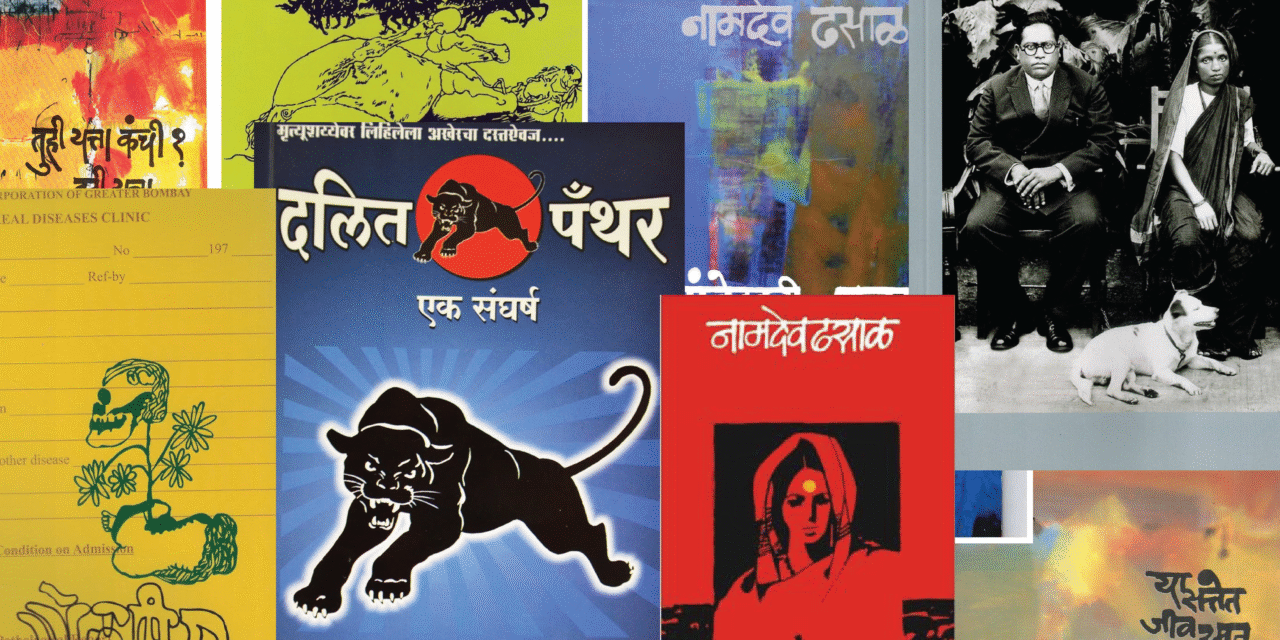
This event celebrates Namdeo Dhasal, a poet who turned pain into poetry and poetry into resistance. Moving through his personal history, the rise of the Dalit Panthers, and his bold political presence, we reflect on the force he became in the anti‑caste movement. His verses in English will echo through the session, carrying the same urgency and beauty that defined his life.
About Namdeo Dhasal
Namdeo Dhasal (1949–2014) is one of the most groundbreaking and uncompromising literary voices in modern India. Poet, writer, activist, and co-founder of the Dalit Panthers, Dhasal revolutionised Marathi poetry by bringing into it the raw, unfiltered realities of caste violence, urban marginality, and the inner life of the oppressed. His poetry — fierce, experimental, and unapologetically political — challenged the aesthetic norms of Indian literature and carved out a new radical tradition of Dalit expression. Reading Dhasal on a global platform is especially important today, as his work speaks not only to the Indian context but to broader struggles for dignity, liberation, and social justice worldwide. His vision continues to inspire anti-caste movements, artists, and scholars across generations.
About Sayali Sahasrabudhe
Sayali Sahasrabudhe, a PhD researcher at Trinity College Dublin, has worked in Indian theatre for over fifteen years and is an accomplished performer and artist. She will be joined by Abhishek Bhosale for a reading of selected poems by Namdeo Dhasal.
Contemporaneity of Marginalities: Gender and Activism in the Age of Tech
12 June 2026, 9-5.30pm.
In person at Bonington Gallery.
More information here.
Although formerly perceived as utopian spaces, digital platforms mirror the contemporary society by replicating and reproducing social hierarchies. Building on this idea, our vision is to facilitate a programme on the intersectionality of caste, Adivasi identity, and gender within the online space with young content creators. How have online platforms shaped marginalised identities? How inclusive are these platforms in empowering their voices? How do young people from marginalised backgrounds engage with social injustice/ activism in this era of rising social media activity? And in this process of visibilising and asserting marginalities, how do the youth envision self-preservation online? These are some of the questions that we will be addressing throughout this event and with a special focus on online practices and their use of technology in negotiating their identities.
Programme:
- 9:00am – 9:30am: Welcome and Registration.
- 9:30am – 10:45am: 1st session with Aleena – Dalit Life, Worlds, Subjectivities.
- 10:45am – 11:15am: Tea break.
- 11:15AM – 12:30 PM: 2nd session – Building AI from the Margins: The Journey of Aindriya Barua and Shhor AI.
- 12:30pm – 1:30pm: Lunch.
- 1:30pm – 2:45pm: 3rd session – Challenges in Representing Tribal Knowledge and Identity in Social Media Culture by Lipsa Hembram.
- 2:45pm – 4:00pm: 4th session with Christina Dhanuja: Anti-Caste Interventions in Contemporary Spaces
- 4:00pm – 4: 30pm: Tea break.
- 4:30pm – 5:30pm: Final session: Round Table with all the speakers and organisers.
Abstracts:
1st Session: Dalit Life, Worlds, Subjectivities by Aleena
This session explores the intersections of literature, caste and lived experience through the work and journey of a Dalit woman writer from Kerala. Drawing from her experiences as a poet and fiction writer, Aleena reflects on how caste shapes literary production, questions of authorship, legitimacy, visibility and belonging within literary and media spaces. The session will explore the possibilities and tensions of writing from a Dalit standpoint, particularly through the lens of womanhood, while engaging with themes such as memory, mythology, faith, violence, joy and everyday realities. It will also reflect on the emotional and political realities of being a Dalit woman writer in contemporary literary culture, including negotiations around representation, tokenism and the burden of speaking from the margins. Ultimately, the session considers literature as a space of resistance, imagination, testimony and world/future making, asking what questions become possible when Dalit women become creators of literary memory.
2nd Session: Building AI from the Margins: The Journey of Aindriya Barua and Shhor AI
This session shares my journey of building Shhor AI, an initiative that came directly out of my lived experience of navigating online violence as a trans non-binary, Indigenous, neurodivergent person from rural Tripura.
For years, my work as a political artist helped me build community, but it also made me a target. The hate speech and doxxing I faced were constant and personal. Existing moderation systems are largely designed in and for the Global North, and they fail to understand the cultural nuance and code-mixed language realities of Indian digital spaces.
Shhor AI emerged from this gap. We built a model trained on over 50,000 crowdsourced comments, annotated by marginalized communities themselves, grounding detection in lived experience. The system identifies hate speech across caste, disability, religion, gender, sexuality, and more within Indian code-mixed contexts. It is designed as a scalable API for real-time moderation.
This session is not just about the technology. It is about what it means to build from where we stand. Shhor has been community-driven and crowdfunded, built without institutional backing but with collective knowledge and urgency.
We will also discuss strategies to make big tech corporations listen to marginalized voices and prioritize our safety. This includes pushing for community-based moderation, building strong evidence, and demanding accountability in how platforms design and enforce safety.
The core idea is simple: marginalized communities are already building solutions. We are not lacking skill. We lack access to resources, networks, and decision-making power. This session asks for a shift from saving us to resourcing and trusting us.
3rd Session: Challenges in Representing Tribal Knowledge and Identity in Social Media Culture by Lipsa Hembram
Tribal identity extends beyond visible cultural expressions such as attire, art, wall paintings, handicrafts, songs, dance, food, or sustainable practices only. Tribal Identity embodies a lived and inherited system of knowledge transmitted across generations through practice. Indigenous crafts and culture have always fascinated the global audience but this has also led to their vulnerability to appropriation, misrepresentation, and loss of contextual meaning. It began with the appropriation of artwork, extended into fashion, and now questions ownership, gradually influencing and reshaping indigenous histories.
Today there is a challenge in documenting and representing tribal knowledge systems, particularly when interpreted through external perspectives that may prioritise aesthetics over authenticity. There is a need to preserving the raw indigenous culture and sharing insights that come from experience and true value. Drawing on observations from community-based practices and contemporary media landscapes, there seems to be a stark difference in these representations. Social media and popular culture contribute to the dilution and distortion of indigenous narratives. These short videos often are made as trends without proper referencing or sources, which sometimes leads to spreading misinformation. We are at the risk of reducing the cultural value of these rich traditions in the process of commercializing them for global consumption.
It is our responsibility to extend efforts towards community-led documentation, where cultural knowledge is authored, co-authored, or validated by community elders and practitioners. The role of the ‘link generation’ in preserving intangible heritage through ethical documentation, research, and representation. This approach seeks to safeguard cultural integrity while enabling meaningful engagement with wider audiences. I plan to emphasize how, without rigorous and authentic research and documentation, tribal histories are at the risk of being altered. This is evident in the way the attire (the patterns of the Phuta saree and the drape) from my community, the Santal tribe, is seeing a major shift in its aesthetics because of contemporary adaptations which are diverging from their cultural roots. Every craft and culture evolves naturally over time, in response to the current zeitgeist, but not at the expense of completely uprooting them from their inherent cultural significance.
4th Session: Anti-Caste Interventions in Contemporary Spaces by Christina Dhanuja
Caste, as a structure and an ideology, continues to shape life across institutions, digital platforms, work spaces, and diasporic cultures. This session led by Christina Dhanuja will begin with a short primer introducing this system of graded hierarchy that is both unique and ubiquitous in its social, economic, and cultural manifestations. The session will then offer a deep dive into three contemporary anti-caste interventions, through the speaker’s own research and creative engagements. Participants will be led through caste-based diversity, equity, and inclusion initiatives within global workplaces and emerging conversations around policy and cultural reforms. The session will then delve into the inspiration and impact of the Dalit History Month project, a digital public archive and a transnational, community-led effort committed to documenting Dalit struggles, intellectual traditions, resistance, and joy. Finally, the session will examine how anti-caste art curation can create spaces for political imagination, public memory, cross-community learning, and new world-building.
Participants:
Aleena
Aleena is a Dalit feminist poet and writer from Kerala whose work explores themes of gender, sexuality, religion, and anti-caste politics. She holds an MA in English Literature from the School of Letters, MG University, Kerala. Her debut poetry collection, Silk Route (2021), which looks into gender, mythology, caste through 91 Malayalam poems was awarded the Kerala Sahitya Akademi Kanakashree Award in 2022. She’s a co-founder and core member of the poetry collective, The Reserved Compartment.
Shohini Barman
Shohini Barman is a Doctoral Candidate in the School of Social Sciences at Nottingham Trent University, United Kingdom. She holds a Bachelor of Arts and Master of Arts degree in English from Jadavpur University, India. Her research interests include Dalit Literature, Rajbanshi Literature, Translation, and South Asian Studies. Her PhD thesis explores the politics of caste in Bengal through the study of contemporary Bengali Dalit Literature and Rajbanshi Literature.
Aindriya Barua
Aindriya Barua (they/them) is a queer Indigenous disabled artist and AI engineer from rural Tripura in northeast India. Their work is at the intersection of ethical artificial intelligence, art, and social justice. They founded Shhor, the UNFPA and World Summit Award winner for its intersectional feminist AI work combating online hate speech, especially against marginalized communities in the Indian context and its linguistic diversity. Aindriya’s work has been featured in national media as well as in art exhibitions across multiple countries. Through their art, they strive to make technology more inclusive, accessible, and rooted in people’s lived experiences.
Mrigakshi Das
Mrigakshi Das is a PhD candidate at Nottingham Trent University, UK. Her research, titled ‘Adivasi Literature and Cinema: Exploring Adivasi Alterity and Assertion’, focuses on questions of identity, resistance, and self-representation within Adivasi cultural production. She holds a Bachelor’s and a Master’s degree in English from the University of Delhi.
Christina Dhanuja
Christina Dhanuja is a writer, researcher, and strategist working at the intersections of caste, gender, faith, and justice. She is the co-founder of the #DalitHistoryMonth project and a founding member of the Global Campaign for Dalit Women. Christina has over 16 years of experience across India, China, Singapore, and the Netherlands, and consults with corporates, nonprofits, faith-based institutions, and universities on leadership development, caste-equity, and accountability frameworks. Her writing has been featured in The Wire, Outlook India, HuffPost, The Swaddle, GenderIT, and Verve. She is currently working on her first book, Dalit Women and the Fullness of Life.
Lipsa Hembram
Lipsa Hembram is the Founder and Creative Head of Galang Gabaan, a brand rooted in indigenous aesthetics and Odisha’s tribal textile heritage. Lipsa has a background in design from the National Institute of Fashion Technology (NIFT). She has been featured in national media including PSBT-DD documentary Kotpad Weaving, and her work has been showcased at various government-led textile initiatives as well as the Lakmé Fashion Week. She has been an invited speaker at academic institutions such as IIT, NIFT, NHDC, and SIDC, and in platforms such as TEDx. She continues to champion design as a tool for cultural preservation, social impact, and inclusive growth.
Basma Mahfoud-Vandermeersch
Basma Mahfoud-Vandermeersch is a PhD candidate at Université de Montpellier Paul-Valéry in co-supervision with BITS Pilani (Goa, India). She investigates the production and reception of translated Dalit writings specifically by Tamil and Telugu Dalit women and activists. Her research interests also consider diasporic writing and the possibilities of transnational collaboration, dialogue, and creation between marginalized communities (Dalits x Blacks x Queers x Muslims x Adivasis).
She is currently based in Paris and teaches ESL full time.
Publishing an anti-caste periodical: Kalyani Thakur Charal in conversation with Sayantan Mondal, Shohini Barman and Nicole Thiara
8 June 2026, 3pm BST
Kalyani Thakur Charal has been editing and publishing Neer Ritupatra, an anti-caste Bangla periodical for almost three decades. Navigating through a time wounded by atrocities on Dalit students and the disenfranchisement of the Dalit population, Neer has emerged as a window to Bengali Dalit women’s writings on Ambedkar, life writings, women’s writing across Indian languages, comparative reflections on caste and race, literary practices among the Bengali scheduled tribe communities. Neer attempts to make sense of anti-caste thought, and intends to forge connections and solidarities across languages and geographies. She will talk about how this journey began, how Neer was produced and circulated and how it survive all these years. What future plans await Neer?
In this conversation with Sayantan Mondal, Shohini Barman and Nicole Thiara, Kalyani Thakur Charal will also discuss her recent collection of critical essays, A Chandalini Speaks, published by Orient BlackSwan, and Andhar Bil’s publication in the UK by Tilted Axis. The conversation will be followed by Q&A.
Kalyani Thakur Charal
Kalyani Thakur Charal is a Dalit feminist and poet writing in the Bengali language. She was born in Bagula, Nadia District, West Bengal, within the Matua community. Her publications include five volumes of poetry, including I Belong to Nowhere and Poems of Chandalini in English translation, an autobiography, a collection of short stories, collections of essays and various special issues of journals on topics such as folklore, water, refugees, and Dalit poetry. Her anthology of Indian women’s writing Dalit Lekhika: Women’s Writings from Bengal (with Sayantan Dasgupta) was published by Stree. Her groundbreaking experimental novel Andhar Bil – and Some People was published in English translation by ZUBAAN and has recently been released in the UK by Tilted Axis.
Dr Sayantan Mondal
Dr Sayantan Mondal is an Associate professor and presently the head of the department of English and Other Languages, GITAM, Hyderabad, India. A graduate from the University of Hyderabad, Sayantan has been an Erasmus Mundus fellow at the University of Oxford. His areas of interest are Print readership, Nineteenth-Century Literature, Anti-caste Studies and Translation. His current research traces Bangla anti-caste Periodical culture (1960-2000) and its relationship with other Indian vernacular anti-caste print culture. In collaboration with Dr. Jondhale Rahul Hiraman, he has created a website (vernacularperiodical.gitam.edu) which provides access to around 10000 pages of Bangla and Marathi anti-caste periodicals. Some of his published works are: Of Caste-Class and Dalit Writing; An Introduction to the World of Monoranjan Byapari; Prantik theke Dalit: Nandonikatar Rajniti o Dalit Chetona (From Marginalised to Dalit: Politics of Aesthetics and Dalit Consciousness).
Shohini Barman
Shohini Barman is a Doctoral Candidate in the School of Social Sciences at Nottingham Trent University, United Kingdom. She holds a Bachelor of Arts and Master of Arts degree in English from Jadavpur University, India. Her research interests include Dalit Literature, Rajbanshi Literature, Translation, and South Asian Studies. Her PhD thesis explores the politics of caste in Bengal through the study of contemporary Bengali Dalit Literature and Rajbanshi Literature.
Dr Nicole Thiara
Dr Nicole Thiara is co-lead of Nottingham Trent University’s Postcolonial and Global Studies Research Group and Principal Investigator on the AHRC-funded Research Network Series ‘Writing, Analysing, Translating Dalit Literature’ and its Follow-on Grant ‘On Page and on Stage: Celebrating Dalit and Adivasi Literatures and Performing Arts’. She teaches postcolonial and contemporary literature at Nottingham Trent University, UK. Her area of research is Dalit and Adivasi literature and her current research project is on the representation of modernity in Dalit literature. Her publications include Salman Rushdie and Indian Historiography: Writing the Nation into Being (Palgrave Macmillan, 2009), ‘The Caste of Nature: Wholesome Bodies and Parasites in Bimal Roy’s Sujata and Gogu Shyamala’s “A Beauteous Light”, The Routledge Companion to Caste and Cinema in India (Routledge, 2022), ‘The Colonial Carnivalesque in Mulk Raj Anand’s Untouchable and Amitav Ghosh’s Sea of Poppies’, Journal of Postcolonial Writing 52: 6 (2016), ‘Subaltern Experimental Writing: Dalit Literature in Dialogue with the World’, Ariel 47:1-2 (2016), pp. 253-80. With Judith Misrahi-Barak and K. Satyanarayana, she co-edited the critical volume Dalit Text: Aesthetics and Politics Re-imagined (Routledge, 2019) and special issue on Dalit Literature in the Journal of Commonwealth Literature 54 (1), March 2019.
Caste in Speculative Fiction: Gogu Shyamala in Conversation with Divya Kalavala and Priteegandha Naik
25 May 2026, 3pm BST (Online here)
With poems, songs and stories, Gogu Shyamala will engage in a dialogue with the writings by Dalit women who unveil mundane lived and shared experiences of those who are located at the lowest strata of society and whose lives are coloured by divisions of class, caste and gender. The context of this intersectional oppression of Dalit women is a civil society that is fragmented by religion, while caste compartmentalises India into 3000 fragments and about 25,000 subdivisions. Unlike religion, the division among castes is invisible but firmly in place. This systematic division, called the ‘Caste System’, is premised on codification of the five-fold varna system. This codification subscribes to an ideology of divisions in a hierarchy akin to a vertical ladder, naturalising and internalising the idea of purity and pollution of castes by religion, effecting untouchability and inhumanity. All top four varnas thereby humiliate the last varna in terms of the economy, ethnicity, culture and assertion.
Gogu Shyamala will discuss how the form of speculative fiction is well suited to explore all these caste contradictions and dichotomies in order to create anti-caste literature and the history of contemporary conditions. She will draw on poems and songs as well as her recently published novelette, “The Phantom Ladder” (in translation from Telugu by Divya Kalavala), in The Blaft Book of Anti-Caste SF by BLAFT Publications.
Gogu Shyamala will be in conversation with Divya Kalavala and Priteegandha Naik, followed by Q&A.
Dr Divya Kalavala
Dr Divya Kalavala is an academic and translator. She was awarded the Charles Wallace India Trust Translation Fellowship for the year 2023–24 at the British Centre for Literary Translation at the University of East Anglia, UK. In the subsequent year, she was awarded the UEA Archives and Collections Visiting Fellowship (2024–25) at the Sainsbury Centre for Visual Arts for her project, ‘Mithila Art from India’.
She holds a doctoral degree in Film Studies from The English and Foreign Languages University and has been teaching at Manipal Academy of Higher Education, Bengaluru. Divya translates from her mother tongue, Telugu, into English and is primarily interested in translating literary texts from the margins as a form of political solidarity.
Dr Priteegandha Naik
Dr Priteegandha Naik is an Assistant Professor at the Mukesh Patel School of Technology Management & Engineering, NMIMS University, where she teaches Communication Skills and other Humanities-centric courses. She is interested in exploring caste and gender in Indian Science Fiction. In particular, she has worked on Dalit Futurism and on understanding Dalit futures in speculative fiction, art, literature, and film and their consequent relevance to the anti-caste movement.
Dr Gogu Shyamala
Dr Gogu Shyamala is one of the foremost contemporary Dalit writers in India, as an award-winning author, researcher, editor, and biographer writing in Telugu. Her collection of short stories Father may be an elephant and mother only a small basket, but… in English translation is a landmark in Indian literature, and her most recent publication is the short story ‘The Phantom Ladder’ (in translation from Telugu by Divya Kalavala), in The Blaft Book of Anti-Caste SF. Among her publications are anthologies of Dalit women’s writings in Telugu, and the biography of the first Dalit woman legislator, T.N. Sadalakshmi in the former state of Andhra Pradesh, India. She is the co-editor of the Oxford Anthology of Telugu Dalit Writing in English (OUP). She holds a PhD in the area of Dalit Women Biographies, Gender and Caste in Telangana, from the English and Foreign Languages University, Hyderabad. She studies Dalit women’s literature and the history and mythology of Dalit literature as well as collecting palm leaf manuscripts of Dalit Puranas for contemporary scholarly studies. Dr Gogu was a research fellow at the Anveshi Research Centre for Women’s Studies, Hyderabad for 21 years, from 1999 to 2020, and she was awarded a fellowship at IAS-Nantes The Institute for Advanced Study of Nantes (2020- 21), France.
In Conversation with Sambhaji Bhagat: the Future of Anti-Caste Cultural Politics in India
May 4th, 3pm
Sambhaji Bhagat will be in conversation with Abhishek Bhosale and reflect on his artistic journey, perform selected songs, and speak about the role of music in shaping anti-caste cultural politics in India.
About Sambhaji Bhagat
Sambhaji Bhagat is one of Maharashtra’s most influential cultural figures — a musician, Lokshahir, and activist whose work spans artistic, intellectual, and social justice spheres. Renowned for his powerful use of folk music, he gives voice to the struggles and aspirations of marginalised communities, particularly Dalits, and his performances across India function not simply as entertainment but as instruments of political education and resistance. His academic engagement and long-standing participation in social movements further reflect his commitment to challenging structural inequalities. His artistic vision is perhaps most widely recognised through the acclaimed film Court, and the theatre play Shivaji Underground in Bhim Nagar Mohalla, where his music played a central narrative and political role, leaving a lasting imprint on contemporary cultural debates.
About Abhishek Bhosale
Abhishek Bhosale is a writer, journalist, and doctoral researcher whose work emerges from more than a decade of engagement with caste, land, and everyday political life in Western India. Currently based in London, he is pursuing his PhD at SOAS University of London, examining the outcomes of land rights in Western India. His research, Land for Emancipation: Development with Dignity and Dalit Land Struggle in India, explores how land becomes a site of dignity, imagination, and resistance for Dalit households. Before entering academia, he worked as a journalist and columnist, travelling extensively across India to report on the agrarian crisis, land conflicts, caste violence, caste boycotts, protest cultures, and the lived experiences of Dalit communities. His writing is shaped by long conversations in drought-prone villages, evenings spent in Dalit vastis, and a commitment to bringing marginalised voices into public discourse. His recent longform piece in The Wire, “An Ambedkarite Voice Moving Through Latur’s Dalit Vastis,” exemplifies his ability to weave reportage with reflective narrative. In 2025, The Wire also profiled his anti-caste organising in UK universities, highlighting the emergence of a new caste critical intellectual culture on British campuses and his role within it. At SOAS he currently serves as President of the SOAS Ambedkar Society, curating events that bring Ambedkarite ideas into dialogue with global student movements. His academic background spans journalism, international relations, and development studies, but his most formative learning has come from years spent documenting the cultural and political life of Dalit communities — recording oral histories, following land and water rights campaigns, and tracing the travel of Ambedkarite thought across rural, academic, and diasporic spaces.
Abhishek Bhosale: Caste-Class Intersection in Anti-Caste Songs of Western India
April 20th, 3pm
Songs have always been an important form of expression in the anti‑caste movement in India. They talk about caste oppression and celebrate the life, work, and values of Dr. Babasaheb Ambedkar and Siddharth Gautam Buddha. But their role doesn’t end there. These songs also raise serious questions about both caste and capitalist society.
This online event will explore how songs contribute to developing a combined understanding of intersections of caste and class in Dalits’ exploitation, struggle and resistance — a framework Abhishek Bhosale refers to as “CLASTE”. It will consider the political life of musical traditions and their capacity to articulate everyday struggles and solidarities.
Abhishek Bhosale will be in conversation with Judith Misrahi-Barak, Purnachandra Naik and Nicole Thiara, followed by Q&A.
About Abhishek Bhosale
Abhishek Bhosale is a writer, journalist, and doctoral researcher whose work emerges from more than a decade of engagement with caste, land, and everyday political life in Western India. Currently based in London, he is pursuing his PhD at SOAS University of London, examining the outcomes of land rights in Western India. His research, Land for Emancipation: Development with Dignity and Dalit Land Struggle in India, explores how land becomes a site of dignity, imagination, and resistance for Dalit households.
Before entering academia, he worked as a journalist and columnist, travelling extensively across India to report on the agrarian crisis, land conflicts, caste violence, caste boycotts, protest cultures, and the lived experiences of Dalit communities. His writing is shaped by long conversations in drought-prone villages, evenings spent in Dalit vastis, and a commitment to bringing marginalised voices into public discourse.
His recent longform piece in The Wire, “An Ambedkarite Voice Moving Through Latur’s Dalit Vastis,” exemplifies his ability to weave reportage with reflective narrative. In 2025, The Wire also profiled his anti-caste organising in UK universities, highlighting the emergence of a new caste‑critical intellectual culture on British campuses and his role within it. At SOAS he currently serves as President of the SOAS Ambedkar Society, curating events that bring Ambedkarite ideas into dialogue with global student movements.
His academic background spans journalism, international relations, and development studies, but his most formative learning has come from years spent documenting the cultural and political life of Dalit communities — recording oral histories, following land and water rights campaigns, and tracing the travel of Ambedkarite thought across rural, academic, and diasporic spaces.
About Prof. Judith Misrahi-Barak
Judith Misrahi-Barak is Professor Emerita in Postcolonial Studies at the English Department, Université de Montpellier Paul-Valéry, France. Her prime areas of specialisation are Anglophone Caribbean and Indo-Caribbean literatures, diaspora and migration. Her monograph in French Entre Atlantique et océan Indien : les voix de la Caraïbe anglophone (2021) was published with Classiques Garnier. She is General Editor of the series PoCoPages published by the University Presses of the Mediterranean (Pulm, Montpellier). She is currently involved in several transdisciplinary collaborative research projects such as Kala Pani Crossings (see the co-edited volumes Kala Pani Crossings, Routledge 2021 & 2023); or ‘Thanatic Ethics: the Circulation of Bodies in Migratory Spaces’ (see the Special Issue for Interventions: International Journal of Postcolonial Studies, 2023). She has also acted as Co-Investigator on AHRC-funded series on Dalit and Adivasi Literatures with Dr NicoleThiara (NTU) as Principal Investigator. In this field, she has co-edited a Special Issue for The Journal of Commonwealth Literature (2019), as well as Dalit Literatures in India (Routledge, 2015), Dalit Text: Aesthetics and Politics Re-imagined (Routledge, 2019) and The Routledge Companion to Caste and Cinema in India (Routledge, 2022).
About Dr. Purnachandra Naik
Dr. Purnachandra Naik is currently teaching at the Centre for Comparative Literature at University of Hyderabad. His PhD research monograph titled “Reading the Rejected: Dirt in Dalit Literature”, which he completed at Nottingham Trent University, is under contract with Routledge. He has published research articles on Dalit literature, caste, animals, and Indian cinema in edited compilations published by Routledge and CUP. His review of the book Dalit Kitchens of Marathwada was published in “Food, Culture and Society” (Taylor & Francis). His reviews and commentaries have also been published in the EPW, Outlook, Indian Express, and The Book Review.
Dr. Nicole Thiara
Dr Nicole Thiara is co-lead of Nottingham Trent University’s Postcolonial and Global Studies Research Group and Principal Investigator on the AHRC-funded Research Network Series ‘Writing, Analysing, Translating Dalit Literature’ and its Follow-on Grant ‘On Page and on Stage: Celebrating Dalit and Adivasi Literatures and Performing Arts’. She teaches postcolonial and contemporary literature at Nottingham Trent University, UK. Her area of research is Dalit and Adivasi literature and her current research project is on the representation of modernity in Dalit literature. Her publications include Salman Rushdie and Indian Historiography: Writing the Nation into Being (Palgrave Macmillan, 2009), ‘The Caste of Nature: Wholesome Bodies and Parasites in Bimal Roy’s Sujata and Gogu Shyamala’s “A Beauteous Light”, The Routledge Companion to Caste and Cinema in India (Routledge, 2022), ‘The Colonial Carnivalesque in Mulk Raj Anand’s Untouchable and Amitav Ghosh’s Sea of Poppies’, Journal of Postcolonial Writing 52: 6 (2016), ‘Subaltern Experimental Writing: Dalit Literature in Dialogue with the World’, Ariel 47:1-2 (2016), pp. 253-80. With Judith Misrahi-Barak and K. Satyanarayana, she co-edited the critical volume Dalit Text: Aesthetics and Politics Re-imagined (Routledge, 2019) and special issue on Dalit Literature in the Journal of Commonwealth Literature 54 (1), March 2019.